Stuck Turbo Syndrome on the 6.7L Cummins: Causes, Fixes & When to Upgrade -DPS
Posted by Diesel Power Source® on Aug 21, 2025
Stuck Turbo Syndrome on the 6.7L Cummins: Causes, Fixes, and When to Upgrade
Stuck Turbo Syndrome - usually shortened to STS - is the single most common turbo problem on the 6.7L Cummins. It happens when the variable geometry vanes inside the factory Holset turbocharger no longer move freely, and it eventually affects almost every 2007.5–2024 Ram 2500 and 3500 if the truck stays on the road long enough. The symptoms range from mild ("the exhaust brake isn't working as well as it used to") to severe (limp mode, complete loss of boost, repeat actuator failures). This guide explains exactly what's happening inside the turbo, how to confirm STS is your problem, and how to decide between a repair and an upgrade.
What Stuck Turbo Syndrome actually is
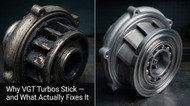
The 6.7L Cummins uses a variable geometry turbocharger - the Holset HE351VE on 2007.5–2012 trucks and the HE300VG on 2013–2024 trucks. Inside the turbine housing is a ring of small movable vanes controlled by an electronic actuator. As the ECM commands the actuator, the vanes open and close to change exhaust flow geometry - closed vanes for fast spool at low RPM, open vanes for high airflow at higher RPM. This same mechanism is what produces the factory exhaust brake.
Stuck Turbo Syndrome is what happens when those vanes stop moving freely. The most common cause is carbon buildup on the vane pivots - soot and oil residue accumulate on the unison ring and the small vane pins until the assembly physically cannot rotate through its full range of travel. Once the vanes stick, the actuator either can't move them at all, or moves them inconsistently. The ECM detects that commanded vane position doesn't match actual vane position and starts setting fault codes.
In high-mileage cases the vanes can seize completely. When that happens, the truck is stuck with whatever vane position the assembly froze in - fully open (no boost, no exhaust brake) or fully closed (excessive backpressure, potential turbo damage from over-speeding the turbine).
Affected engines and year ranges
| Year range | Engine | Factory turbo | STS prevalence |
|---|---|---|---|
| 2007.5–2012 | 6.7L Cummins | Holset HE351VE | Very common, typically appears 50,000–150,000 miles |
| 2013–2018 | 6.7L Cummins | Holset HE300VG | Very common, typically appears 50,000–150,000 miles |
| 2019–2024 | 6.7L Cummins | Holset HE300VG (continued) | Common, especially on emissions-equipped trucks with extended oil drain intervals |
The same failure mechanism occurs on the Cummins ISX15 and X15 commercial engines, but the upgrade paths are different - see our ISX15 turbo upgrade guide for those platforms. The 5.9L Cummins and 12V Cummins are not affected because they use fixed-geometry turbos with no movable vanes.
Symptoms of Stuck Turbo Syndrome
If you're seeing any combination of the following on a 6.7L Cummins, STS is the most likely cause:
- Sluggish throttle response - the truck feels lazy off idle, especially when cold
- Reduced or erratic boost - boost gauge readings that are lower than they used to be, or that fluctuate when they should be steady
- Exhaust brake stops working or works intermittently - exhaust brake function depends entirely on vane movement
- Black smoke under load - an indicator that fueling is correct but airflow isn't keeping up
- Higher EGTs than normal, especially while towing
- Limp mode - the ECM cuts power when it can't control vane position within acceptable limits
- Fault codes, most commonly P003A, P2262, P226C, P00AF, and P0299
If you're seeing any of those codes, our detailed guide on P003A, P2262 and P226C codes on the 6.7 Cummins walks through the diagnostic order of operations for each one.
What causes Stuck Turbo Syndrome
Three failure modes account for the vast majority of STS cases:
Carbon buildup on the vane assembly. This is the most common cause and the reason mileage is the strongest predictor of STS. Soot and partially burned oil accumulate on the vane pivots and the unison ring that links them. Eventually the buildup is thick enough to physically restrict vane movement. Engines that see frequent short trips, extended idling, or extended oil drain intervals develop this buildup faster.
Actuator wear. The electronic actuator on the 6.7L Cummins contains an internal motor, position sensor, and control electronics - all mounted directly to the outside of a turbo running at extreme heat. Actuators wear out independently of the vane assembly. In some cases the vanes are still free but the actuator can no longer move them through their full range of travel.
Oil coking. Engines with oil consumption issues, failing turbo seals, or extended oil drain intervals develop oil-based deposits on the vane assembly that are far harder to clean than dry soot. Oil coking accelerates STS significantly and is a leading reason some trucks fail at 60,000 miles while others go 200,000+ miles before symptoms appear.
Repair vs. upgrade - how to decide
Once STS is confirmed, the question is whether to repair the factory unit or upgrade to a stronger system. The honest answer depends on the truck's mileage, condition, and how it's used.
A repair makes sense when:
- The truck has under 150,000 miles
- The vanes themselves are still mechanically free (the actuator is the failure)
- The truck is stock or mildly tuned with no plans to add power
- The truck has not had a previous VGT failure
- Emissions compliance must be maintained and budget is the priority
In these cases, a quality replacement actuator paired with a proper VGT relearn procedure resolves the codes and restores normal operation. If the vanes are partially gummed but not seized, professional cleaning of the vane assembly is also an option.
An upgrade makes sense when:
- The truck has high mileage and has already had at least one VGT failure
- The vanes themselves are worn, damaged, or fully seized
- You want a permanent fix rather than a likely-to-repeat repair
- You're planning a tune or other performance upgrades
- You want better drivability and faster spool than stock
This is where Diesel Power Source® offers two upgrade paths depending on whether you want to stay on the VGT platform or eliminate it entirely.
Upgrade option 1: Turbonator® VGT
The Turbonator® VGT is a direct-fit replacement for the factory HE351VE or HE300VG that keeps the truck on the VGT platform — and keeps the factory exhaust brake — while solving the underlying causes of STS. It is the right upgrade for emissions-equipped trucks, towing-focused builds, and any owner who wants the drivability benefits of variable geometry without the failure points of the stock unit.
What's mechanically different from a stock or stock-modified VGT:
- Patented ball-bearing unison ring — replaces the factory bushed unison ring with a ball-bearing design that is far less prone to binding from soot and oil buildup
- CFD-tested housing geometry — flows 71% more air than the factory turbo
- Heavier-duty internals — built around stronger components than the OEM unit
- Maintains all factory functions — exhaust brake, warm-up cycle, EGR compatibility, and emissions equipment all retained
- Pre-calibrated and ready to install — no relearn complications
Documented improvements include 200–600 RPM faster spool than the factory turbo and 10–25% horsepower gains depending on the truck's existing supporting modifications.
The Turbonator® VGT is available as a complete S300 ball-bearing turbo for 2007.5–2018 6.7L trucks, and as a Turbonator® VGT housing upgrade for owners who already have a quality S300 or S400 aftermarket turbo and want to add VGT capability to it.
Upgrade option 2: 3rd Gen Swap Kit
For deleted trucks or builds where you want to eliminate the VGT system entirely, the DPS 3rd Gen Swap Kit replaces the factory turbo and manifold with a 3rd-generation-style fixed-geometry S300 turbo and a DPS 2-piece high-flow exhaust manifold. With no electronic actuator, no movable vanes, and no position sensors, this is a permanent fix - STS cannot return because the components that fail in STS are no longer on the engine.
The 3rd Gen Swap Kit is available in eight turbo configurations from 530 HP to 1,000 HP and installs in approximately 3 hours on a truck that's already been deleted. The turbo and manifold stay in the factory location, so the kit bolts to the stock exhaust, intake, and intercooler connections without additional piping or adapters. A programmer is required for turbo delete on the 6.7L; Diesel Power Source® does not provide emissions delete items, but the kit works on trucks that have already been deleted.
The base 3rd Gen Swap Kit gives up the factory exhaust brake - fixed-geometry turbos cannot create exhaust braking. To keep exhaust braking after the swap, choose the optional Turbonator® VGT housing upgrade at checkout.
Frequently asked questions
Will cleaning my stock VGT actually fix Stuck Turbo Syndrome long-term?
Cleaning resolves STS short-term in cases where the vanes are gummed but not seized, but it does not address the underlying cause. The same conditions that produced the original buildup - soot loading, heat cycles, oil residue - will produce it again. Cleaning is a reasonable repair on a low-mileage truck. On a high-mileage truck with a previous failure, cleaning typically buys 12 to 24 months before symptoms return.
Does the Turbonator® VGT keep my factory exhaust brake?
Yes. The Turbonator® VGT retains exhaust brake function along with all other factory VGT behaviors including warm-up cycle and EGR compatibility. This is the primary reason towing-focused 6.7L Cummins owners choose the Turbonator® VGT over the 3rd Gen Swap Kit.
Do I need a tuner to install the Turbonator® VGT?
No. The Turbonator® VGT is a direct-fit replacement for the factory HE351VE or HE300VG and runs on factory tuning. The 3rd Gen Swap Kit, by contrast, requires a programmer because it replaces the factory turbo entirely and the truck must already be deleted.
Is the Turbonator® VGT emissions-compatible?
Yes. The Turbonator® VGT maintains compatibility with all factory emissions equipment including the EGR system, DPF, and SCR. It is the upgrade path for owners who must retain emissions for inspection or registration purposes.
Why does my exhaust brake stop working before any other STS symptom?
Exhaust brake function requires the vanes to close further and faster than normal driving requires. Even partial vane sticking eliminates exhaust braking before it noticeably affects boost or throttle response. A weakening exhaust brake is often the earliest sign of STS and is worth taking seriously - it indicates the vane mechanism is starting to bind even if no codes have been set yet.
How can I prevent STS on a new or recently repaired 6.7L Cummins?
The most effective preventive measures are using factory-recommended oil change intervals (not extended), allowing the engine to fully warm up before heavy load, allowing a brief idle-down period after hard pulls before shutdown, and using the factory exhaust brake regularly during normal driving - exhaust brake operation cycles the vanes through their full range of travel and helps prevent the partial-position sticking that develops when vanes only see a narrow operating range.
Ready to fix Stuck Turbo Syndrome?
Diesel Power Source® offers the full range of solutions for 6.7L Cummins VGT problems - from direct-fit factory replacements through upgraded VGT systems to complete VGT eliminations.
- Turbonator® VGT Upgrades for 6.7 Cummins
- DPS HE300VG Direct Replacement Turbo
- 3rd Gen Swap Kit for 2007.5–2018 6.7 Cummins
- All 6.7 Cummins Stock Replacement Parts
Not sure which path is right for your truck? Use our Turbo Selector tool or contact our team directly - we'll help match the right solution to your power goals, budget, and emissions requirements.