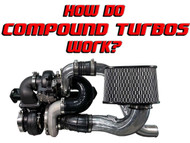
How Do Compound Turbos Work? Diesel Twin Turbos Explained
Posted by Will on Oct 17, 2025
How Do Compound Turbos Work? Diesel Twin Turbos Explained
Compound turbochargers are the most effective airflow upgrade available for a diesel engine. On a 5.9L or 6.7L Cummins they are the difference between fighting high EGTs on every mountain grade and running cool and controlled under the heaviest loads. They are also the foundation of every serious diesel performance build targeting 600 HP and beyond.
This guide explains exactly how compound turbo systems work, why they lower exhaust gas temperatures so effectively, how they compare to single turbo setups, and what to consider when choosing a compound configuration for your specific truck and use case.
Watch: Compound Turbos Explained
Video Summary
The video above shows how a Diesel Power Source® compound turbo kit routes air through both turbos in series and why the result is cooler, denser charge air with strong boost from low RPM through the top end. The written guide below covers the technical details in full.
What Is a Compound Turbo System?
A compound turbo system — also called a twin turbo or series turbo setup — uses two turbochargers connected in sequence rather than a single turbo working alone. The two turbos have distinct roles:
The small high-pressure turbo mounts directly to the exhaust manifold. It is the first turbo exhaust gas encounters after leaving the cylinders. Because it is smaller, it spools quickly on relatively low exhaust flow — delivering boost early in the RPM range where a large single turbo would still be winding up.
The large low-pressure turbo sits downstream, typically mounted in the engine bay or on a bracket ahead of the engine. It receives the compressed air output from the small turbo and compresses it a second time before it reaches the intercooler. At higher engine speeds and loads, the large turbo becomes the primary airflow supplier, moving volumes of air that a small turbo simply cannot flow.
Together, the two turbos work as a system. Neither turbo alone could deliver what both deliver together — which is the core of why compounds are so effective.
How Compound Turbos Work: Step by Step
Understanding the airflow path makes the system's advantages clear.
Step 1: The large low-pressure turbo draws ambient air in through its inlet and compresses it moderately — typically to a relatively low pressure ratio. This pre-compressed air is warm but not yet at full charge temperature.
Step 2: That pre-compressed air exits the large turbo's compressor outlet and travels through crossover piping to the inlet of the small high-pressure turbo. The small turbo is now receiving air that is already denser than ambient — it starts with an advantage.
Step 3: The small turbo compresses the pre-compressed air a second time, raising it to the final target boost pressure. Because it is working with denser inlet air, the small turbo achieves high outlet pressure while spinning at lower shaft speeds than it would need if starting from ambient.
Step 4: The fully compressed charge air exits the small turbo's compressor outlet and travels to the intercooler, where heat is removed before the air enters the engine.
The exhaust side mirrors this in reverse. Exhaust gas from the engine hits the small turbo's turbine first, driving the small turbo. The exhaust then exits the small turbo and travels to the large turbo's turbine, which extracts additional energy before releasing exhaust to the downpipe and exhaust system.
Why Compound Turbos Lower EGTs So Effectively
Exhaust gas temperature is a measure of how much heat energy is leaving the engine unburned through the exhaust. High EGTs mean the combustion event is still producing heat as the exhaust valve opens — heat that should have been converted to mechanical work. The primary cause of high EGTs in a diesel is insufficient airflow relative to fuel quantity.
Compound turbos address this directly by delivering more total airflow than a single turbo can provide. More air means more complete combustion, which means more energy is extracted as mechanical work during the power stroke and less exits as heat through the exhaust. The 200 to 300 degree EGT reduction that compound setups routinely achieve is not a side effect — it is a direct result of supplying the engine with the air it needs to burn fuel efficiently.
There is a secondary benefit as well. Because each turbo in a compound system handles a lower pressure ratio than a single turbo trying to do all the work alone, each turbo operates closer to the center of its efficiency island. This means less heat of compression is added to the charge air at each stage, resulting in cooler, denser air entering the engine even before the intercooler does its job.
Compound Turbos vs. Single Turbos: What Changes
The differences between a well-matched compound setup and a single turbo are significant enough that they affect how the truck drives every time it is under load.
Spool response: A large single turbo capable of supporting 600 HP has a turbine wheel sized to flow that volume of exhaust — which means it needs substantial exhaust flow before it builds boost. The small turbo in a compound system spools on a fraction of that exhaust flow, delivering boost well before the large turbo is contributing meaningfully. The result is throttle response that feels more like a smaller turbo while still having the top-end airflow of a large one.
EGT reduction: A single large turbo running high boost produces significant heat of compression, and at high power levels generates substantial exhaust backpressure that limits how efficiently the engine can breathe. Compounds reduce backpressure by splitting the work between two turbines, and reduce charge temperature through two-stage compression at lower individual pressure ratios.
Power ceiling: The practical power ceiling of a single turbo on a 5.9 or 6.7 Cummins is around 500 to 550 HP before airflow becomes the limiting factor. Compound setups push that ceiling to 700, 800, or higher depending on turbo sizing — without the drivability penalties that come from a single large turbo on a street truck.
Compound Turbo Configurations: Choosing the Right Sizes
The two most common compound configurations for Cummins engines are S300/S400 and S300/S300. Understanding what each delivers helps match the setup to how the truck is actually used.
S300/S300 — a small S300-frame turbo paired with a larger S300-frame turbo — is well suited to daily drivers and moderate towers targeting 500 to 650 HP. The smaller overall size of both turbos keeps spool response sharp and drivability excellent. EGT reduction is meaningful, typically 175 to 250 degrees under tow loads in the 12,000 to 18,000 pound range.
S300/S400 — typically a pairing like an S366 as the small turbo and an S475 as the large turbo — is the most popular compound configuration for a reason. The large S400-frame secondary turbo flows significantly more air at high loads, supporting 600 to 750 HP and handling tow loads of 18,000 to 25,000 pounds with 200 to 300 degree EGT reductions. This is the configuration most hot-shot drivers and heavy towers run. It maintains strong drivability while delivering top-end airflow that S300/S300 setups can't match.
S400/S400 — two large S400-frame turbos — is reserved for competition, sled pulling, and extreme builds targeting 750 to 900 HP or more. This configuration requires extensive supporting modifications and is not practical for daily driving or towing applications.
Complete Compound Kits vs. Add-A-Turbo Kits
Diesel Power Source® offers two paths to a compound turbo system, and the right choice depends on what is already on the truck.
A complete compound kit includes both turbos — the small high-pressure unit and the large low-pressure unit — along with the exhaust manifold, all piping, oil lines, and mounting hardware. This is the right starting point for trucks on a stock turbo or for owners who want a completely fresh, matched system with no question about turbo compatibility. Every component in the kit is engineered to work together.
The Add-a-Turbo kit includes only the large secondary turbo plus all the piping and hardware to integrate it with an existing turbo. If the truck already has a quality upgraded S300, S400, or VGT unit, the Add-a-Turbo kit converts that existing setup to compounds at a lower cost by using the current turbo as the high-pressure stage. For emissions-equipped 6.7L trucks, this path is also emissions-compatible — the factory VGT remains in place as the small turbo, and the large secondary turbo adds airflow without requiring removal of any emissions equipment.
Compound Turbo Kits by Cummins Generation
Diesel Power Source® manufactures compound kits for every major generation of Cummins-powered truck. Each kit is engineered specifically for that engine bay's geometry and includes all components needed for installation without custom fabrication.
- 12V Cummins Compound Kit — 1989 to 1998 (1st gen and early 2nd gen)
- 24V Cummins Compound Kit — 1998.5 to 2002 (2nd gen VP44)
- 5.9 Cummins Compound Kit — 2003 to 2007 (3rd gen common rail)
- 6.7 Cummins Compound Kit — 2007.5 to 2018 (4th gen)
- Add-a-Turbo Kit — 5.9 and 6.7 Cummins (emissions-compatible option for 6.7)
Not sure which configuration is right for your truck and power goals? Use the DPS Turbo Selector or contact the team directly.
Frequently Asked Questions: How Compound Turbos Work
What is the difference between a compound turbo and a twin turbo?
Compound turbo and twin turbo refer to the same basic concept — two turbochargers working together on the same engine. In diesel performance, the terms are used interchangeably. The specific arrangement used on Cummins compound kits is a series configuration: one turbo feeds compressed air into the other rather than each turbo supplying a separate bank of cylinders. This is different from the parallel twin-turbo setups found on some gasoline V8 engines, where each turbo feeds half the engine independently.
Why do compound turbos lower EGTs so much compared to a single turbo?
Compound turbos lower EGTs primarily by supplying more total airflow to the engine, enabling more complete combustion and more efficient extraction of energy during the power stroke. When more heat is converted to mechanical work, less exits through the exhaust. A secondary factor is that two-stage compression at lower individual pressure ratios generates less heat of compression than a single turbo achieving the same final boost pressure in one stage. Together these factors produce the 200 to 300 degree EGT reductions that compound setups consistently deliver under tow loads.
Do compound turbos have more turbo lag than a single turbo?
Properly matched compounds actually have less perceived lag than a large single turbo at equivalent power levels. The small high-pressure turbo in a compound system spools on modest exhaust flow, delivering boost early in the RPM range. The large low-pressure turbo builds boost progressively as exhaust flow increases. The result is a wider, smoother boost curve rather than the characteristic wait-then-surge of a large single turbo. This is one of the reasons compound setups are preferred for working trucks — the drivability under load is significantly better than a comparably capable large single.
How much horsepower can a compound turbo system support on a 5.9 Cummins?
On a 5.9L Cummins, a well-matched S300/S400 compound setup with supporting fuel modifications can support 650 to 750 HP. S400/S400 configurations with full supporting modifications can push past 850 HP on the right build. The engine's mechanical limits — rotating assembly, head studs, and injector capacity — become the constraint before the turbo system does in most cases. For street and tow applications, the S300/S400 configuration in the 600 to 700 HP range is the practical sweet spot that delivers maximum real-world benefit without requiring full engine reinforcement.
Can any diesel engine run compound turbos or only Cummins?
Compound turbo systems can be applied to any diesel engine with sufficient exhaust flow to drive two turbos. In the diesel truck market, Cummins-powered trucks are the most common platform for compound builds due to the inline-six engine's strong low-end torque, mechanical simplicity relative to V8 competitors, and the large aftermarket ecosystem around the 5.9L and 6.7L platforms. Diesel Power Source® compound kits are currently designed for Cummins applications across all major generations.
What is the best compound turbo setup for heavy towing on a 6.7 Cummins?
For a 6.7L Cummins used for heavy towing — fifth wheel, gooseneck, or hot-shot loads in the 18,000 to 30,000 pound range — the S300/S400 compound configuration is the most proven choice. It delivers the combination of low-RPM spool needed for pulling from a stop under load, sustained boost at highway speeds, and the 200 to 300 degree EGT reduction that keeps the engine cool on long grades. For emissions-equipped trucks that need to remain legal, the Add-a-Turbo kit delivers the same benefits while keeping factory emissions equipment intact.
Do I need a tune when adding a compound turbo system?
Yes, and this is not optional. Running a compound turbo system on a single-turbo tune creates problems — the boost and fueling tables are calibrated for a single turbo's response curve and pressure characteristics, not a compound system. A compound-specific tune adjusts boost targets, fueling strategy, and timing to take full advantage of the airflow the compound setup provides. Without proper tuning, you will not see the full EGT reduction or power benefit, and you risk running conditions the engine was not calibrated to handle. A quality compound tune from a diesel performance tuner familiar with the platform is a required part of the installation.
Ready to explore compound kits for your truck? Browse the full lineup at dieselpowersource.com/compound-turbo-kits or use the Turbo Selector to find the right configuration for your generation, power goals, and use case.