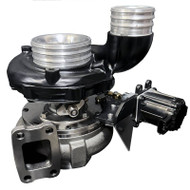
VGT Turbochargers for Cummins: The Complete Guide
Posted by Will on Apr 06, 2026
VGT Turbochargers for Cummins Engines: The Complete Guide
The variable geometry turbocharger — commonly called a VGT — is one of the most significant pieces of technology in modern Cummins diesel performance. It replaced the fixed-geometry turbos of earlier generations and brought with it better spool response, improved fuel economy, and integrated engine braking. It also brought a new set of failure points that Cummins owners deal with regularly.
This guide covers everything you need to know about VGT turbochargers on Cummins engines: how they work, which engines use them, the most common problems, actuator replacement, controller diagnostics, and your upgrade options when the stock unit no longer meets your needs.
What Is a VGT Turbocharger and How Does It Work?
A variable geometry turbocharger uses a set of movable vanes inside the turbine housing to change the effective size of the exhaust inlet. By adjusting the vane position, the turbo can behave like a small, fast-spooling turbo at low RPM and like a large, high-flow turbo at high RPM — all from a single unit.
On Cummins applications, those vanes are controlled by an actuator — either a pneumatic actuator on earlier systems or an electronic actuator on more recent engines. The engine's ECM monitors boost pressure, exhaust backpressure, and engine load, then commands the actuator to open or close the vanes accordingly.
When the vanes close, exhaust velocity increases and the turbo spools faster. When they open, restriction drops and the turbo flows more air for high-RPM power. This is also the mechanism behind exhaust brake function on trucks equipped with VGT turbos — closing the vanes creates substantial backpressure that slows the vehicle without touching the friction brakes.
Which Cummins Engines Use VGT Turbochargers?
Variable geometry technology arrived on Cummins engines with the 6.7L ISB, introduced in the 2007.5 Ram 2500/3500. It is also found on the following platforms:
- 6.7L Cummins (ISB6.7) — 2007.5–present Ram 2500/3500 and 4500/5500
- Cummins ISX and X15 — on-highway heavy-duty semi applications
- Cummins ISM / QSM11 — medium-duty truck and industrial applications
- Cummins ISL and QSL — medium-duty applications including bus and RV
The 5.9L Cummins (24-valve and 12-valve) used fixed-geometry Holset turbos and does not use variable geometry. If you're running a pre-2007 engine and want VGT characteristics, a compound turbo setup or a larger single fixed-geometry upgrade are the common paths.
Common VGT Turbocharger Problems on Cummins Engines
The variable geometry mechanism introduces complexity that fixed-geometry turbos simply don't have. The vanes and their pivot pins are exposed to high exhaust temperatures and soot-laden gases. Over time, this leads to predictable failure patterns.
Stuck or Sticking Vanes
Carbon buildup on the vane assembly is the most common VGT failure on Cummins engines. When the vanes stick in a partially open or closed position, the turbo can't respond to actuator commands. Symptoms include sluggish throttle response, black smoke, low boost, and active fault codes. In severe cases, the vanes seize completely — either wide open (low boost, no engine braking) or closed (excessive backpressure, potential turbo damage).
Actuator Failure
The electronic actuator on the 6.7L Cummins is a known weak point. It contains an internal motor, position sensor, and control electronics — all mounted to the outside of a turbo that runs at extreme heat. Actuator failures can cause fault codes P2262, P226C, or related VGT position codes. In many cases the vanes themselves are fine; only the actuator needs replacement.
Turbo Housing Wear
Vane pivot pin wear and unison ring wear develop over high mileage. This causes vane movement to become inconsistent even when the actuator functions correctly, resulting in erratic boost control and codes that don't resolve with actuator replacement alone.
Oil Contamination
The VGT vane assembly is particularly sensitive to oil coking. Engines with oil consumption issues, failing turbo seals, or inadequate oil change intervals tend to develop vane sticking more quickly. Maintaining clean, fresh oil is the single most effective preventive measure for VGT longevity.
VGT Turbo Actuators: Replacement and Diagnostics
On the 6.7L Cummins, the actuator bolts directly to the turbocharger and communicates with the ECM via a dedicated circuit. When the ECM detects that the actual vane position doesn't match the commanded position — or can't reach a target within a set timeframe — it sets a fault code and often enters a limp mode with reduced boost.
Diagnosing the Actuator vs. the Vanes
Before replacing an actuator, confirm whether the vanes themselves can move freely. With the engine off and cool, some actuators can be manually commanded through a scan tool that supports bi-directional VGT control. If the actuator moves but the vanes don't follow, the problem is internal to the turbo. If the actuator itself won't move or reports a position fault, the actuator is the likely culprit.
Actuator Replacement
Replacement actuators are available in OEM Holset spec and aftermarket options. When replacing, the new actuator typically requires calibration — a learned position procedure performed with a scan tool so the ECM knows the actuator's full range of travel. Skipping this step will result in continued fault codes even with a good new actuator installed.
VGT Controllers and Aftermarket Control Options
For performance applications, aftermarket VGT controllers allow manual or tuner-controlled adjustment of vane position independent of stock ECM logic. This is particularly useful in tuned trucks where the factory boost targets are raised significantly — the stock controller may not open the vanes aggressively enough to support elevated fueling, leading to excessive backpressure and EGTs. An aftermarket VGT controller addresses this directly.
VGT Turbo Upgrade Options for the 6.7L Cummins
For trucks used primarily for towing, the stock VGT with an actuator replacement and a good tune handles a significant amount of additional fueling before it becomes the limiting factor. Most 6.7L owners see the VGT become restrictive around the 550–600 RWHP range, depending on altitude and tuning strategy.
Upgraded Drop-In VGT Units
Several manufacturers offer direct-replacement VGT units for the 6.7L with larger compressor wheels, upgraded bearing systems, and improved vane assemblies. These are bolt-in upgrades that retain the factory mounting and actuator interface, making installation straightforward and preserving exhaust brake function.
Fixed-Geometry Turbo Conversions
High-output builds — particularly compound setups — sometimes replace the VGT entirely with a fixed-geometry turbo using a T4 or T6 manifold adapter. This eliminates the vane mechanism entirely, removing a failure point and allowing use of larger turbos not available in VGT form. The tradeoff is loss of exhaust brake function and a turbo that may spool more slowly at low RPM.
Compound Turbo Systems
Adding a large atmospheric turbo in front of the factory VGT is the most popular performance path for high-output 6.7L builds. The compound arrangement lets the VGT function in its efficient range while the primary turbo supplies pre-compressed air, dramatically increasing total airflow capacity. Properly set up, compounds on a 6.7L can support 700+ RWHP while maintaining excellent street manners.
Maintenance Tips to Extend VGT Turbo Life
- Use quality oil and don't extend drain intervals. The VGT vane assembly is the first component to suffer from degraded or dirty oil.
- Allow idle-down time after hard pulls. Shutting the engine off immediately after towing allows heat to soak into the turbo bearings without oil circulation. A 3–5 minute idle lets temperatures stabilize.
- Address boost leaks promptly. Boost leaks force the VGT to work harder to maintain target pressure, increasing vane cycling and wear.
- Monitor EGTs if tuned. Excessive exhaust temperatures accelerate carbon buildup on the vane assembly. Keeping EGTs in check directly protects the turbo.
- Clean or inspect the vane assembly at high mileage. On trucks with 150,000+ miles, a turbo inspection and cleaning — even without active fault codes — can prevent a roadside failure.
Frequently Asked Questions: VGT Turbochargers for Cummins
What does VGT stand for on a Cummins turbo?
VGT stands for Variable Geometry Turbocharger. It refers to a turbocharger design that uses adjustable internal vanes to change the flow characteristics of the turbine, allowing the turbo to behave differently at low and high engine speeds. On Cummins diesel engines, VGT technology was introduced with the 6.7L ISB in 2007.5 and is controlled by an electronic actuator mounted to the turbo housing.
What are the symptoms of a failing VGT turbo on a 6.7 Cummins?
Common symptoms include low or erratic boost pressure, sluggish throttle response, excessive black smoke, reduced fuel economy, loss of exhaust brake function, and active fault codes such as P2262 or P226C. In severe cases the truck may enter limp mode with significantly restricted power. These symptoms can result from actuator failure, stuck vanes due to carbon buildup, or internal turbo wear.
Can I replace just the actuator on my 6.7 Cummins VGT turbo?
Yes, in many cases the actuator can be replaced independently of the turbocharger. This is a common repair on high-mileage 6.7L Cummins trucks. After replacement, the actuator must be calibrated using a scan tool with bi-directional VGT control so the ECM can learn the full range of actuator travel. If the vanes themselves are stuck or damaged, actuator replacement alone will not resolve the issue.
What is the difference between a VGT turbo and a fixed-geometry turbo?
A fixed-geometry turbo has a stationary turbine housing with no moving vanes — its flow characteristics are determined entirely by the housing dimensions and are constant across all RPM ranges. A VGT turbo uses movable internal vanes to vary the turbine's effective size, allowing it to spool quickly at low RPM and flow high volumes of air at high RPM. VGT turbos also enable exhaust brake function; fixed-geometry units do not.
At what power level does the stock 6.7 Cummins VGT turbo become restrictive?
The stock VGT on the 6.7L Cummins is generally considered adequate up to approximately 550–600 RWHP, depending on altitude, tune, and the specific turbo variant (there are several generations of 6.7L VGT). Beyond that range, exhaust backpressure climbs steeply, EGTs increase, and airflow becomes the limiting factor. Upgraded drop-in VGT units or compound turbo setups are the common solutions for builds targeting higher power levels.
Will replacing the VGT with a fixed-geometry turbo eliminate exhaust brake function?
Yes. Exhaust braking on VGT-equipped Cummins trucks is a direct function of the variable vanes being commanded closed by the ECM. A fixed-geometry turbo has no vanes to close, so this function is lost entirely. Trucks that do significant mountain driving or tow heavy loads should weigh this tradeoff carefully before converting to a fixed-geometry setup.
What is a VGT controller and do I need one for a tuned 6.7 Cummins?
A VGT controller is an aftermarket device that allows independent control of vane position, separate from or supplementing the factory ECM commands. For heavily tuned trucks — especially those with significantly elevated fueling and boost targets — the factory VGT control strategy may not open the vanes aggressively enough to manage backpressure efficiently. An aftermarket controller addresses this and can meaningfully reduce EGTs and improve spool characteristics on high-output builds.
Ready to Upgrade Your Cummins Turbo?
Diesel Power Source carries a full selection of VGT turbochargers, replacement actuators, VGT controllers, and compound turbo kits for Cummins diesel engines. Whether you're diagnosing a fault code or building a high-output tow rig, our team can help you select the right parts for your application.