Compound Turbo Systems That Don't Require Custom Fabrication?
Posted by Hunter on Feb 17, 2026
Which Brands Make Compound Turbo Systems That Don't Require Custom Fabrication?
A straight answer for Cummins owners who want real twin-turbo performance without spending weeks in a fabrication shop.
If you've looked into compound turbo setups for your Cummins, you've probably seen the builds online that look incredible — and then discovered the fine print: custom crossover pipes, one-off mounting brackets, hours of mock-up work, and a welder who really knows what they're doing. That's a legitimate path for some people, but it's not the only one.
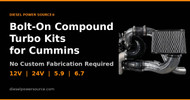
There are bolt-on compound turbo systems built specifically for Cummins engines that ship with every component needed for installation - no custom fabrication, no hunting for fittings, no guessing whether two turbos from different sources will actually play well together. This post covers who makes them, what's included, and how to figure out which kit fits your truck and your goals.
Why Compound Turbos Are Worth Considering for a Cummins
Compound turbo systems, also called twin turbos or compounds - use two turbochargers in series. A smaller high-pressure turbo mounts to the exhaust manifold and handles spool at low RPM. A larger low-pressure turbo sits downstream and takes over at higher airflow levels. The result is faster response at the bottom of the power band and significantly more airflow at the top.
For Cummins owners who tow heavy loads, the practical benefit is lower exhaust gas temperatures (EGTs). A well-matched compound setup can reduce EGTs by 200–300°F compared to a single turbo running the same fuel, which means more headroom before you're in territory where you risk engine damage. For those chasing horsepower, compounds open up the 600–900+ HP range that a single turbo simply can't support on a 5.9 or 6.7 Cummins.
The challenge has always been fitment. Two turbos, a new manifold, crossover piping, oil lines, mounting hardware — all of it has to fit in the engine bay of a specific truck, without interfering with steering, A/C, intercooler piping, or anything else under the hood. That's where purpose-built kits make the difference.
What Makes a Compound Kit "Bolt-On"?
A true bolt-on compound kit is designed from the ground up for a specific engine and generation. Every component is engineered to fit together and fit the truck without modification. When you see a kit described as bolt-on, here's what that should mean:
- Both turbos included and sized to work together. The small and large turbo are matched - not just picked from a catalog - so they complement each other's flow characteristics. Mismatched compounds create boost spikes, backpressure problems, and lag.
- Application-specific manifold. The exhaust manifold is made for your engine's flange pattern and bolt spacing. On a 5.9 Cummins you'll typically be working with T3 or T4 flanges; the manifold needs to match both the head and the small turbo's inlet.
- Pre-bent crossover and intercooler piping. This is where custom builds get time-consuming. A real bolt-on kit includes all piping pre-bent to clear your specific engine bay's obstacles.
- Oil and coolant lines. Both turbos need oil feed and drain. Feed lines connect to the engine oil system; drain lines return oil to the pan. All fittings, banjo bolts, and lines should be in the box.
- All mounting hardware. Studs, clamps, couplers, gaskets - nothing should require a trip to the hardware store or specialty fastener supplier.
If any of those components are missing, you're not looking at a bolt-on kit - you're looking at a partial kit that will require fabrication to complete.
Diesel Power Source® Compound Turbo Kits: What's Available by Generation
Diesel Power Source® designs and manufactures compound turbo kits specifically for Cummins-powered Dodge trucks across all major generations. Every kit is engineered for the specific engine bay and includes both turbos plus all required components. Here's what's available:
12V Cummins - 1989 to 1998 (1st Gen and Early 2nd Gen)
The 5.9 12-valve is the most mechanically straightforward Cummins to build on. No common rail, no electronic fuel system to work around — just a mechanical P-pump and an engine that responds well to airflow improvements.
DPS Compounds for 12V Cummins (1989–1998) - $3,924 to $7,164
This kit fits both 1st gen (1989–1993) and early 2nd gen (1994–1998) 12-valve trucks. It includes a matched small and large turbo, the appropriate exhaust manifold, crossover piping, oil lines, and all hardware. The kit is designed around the 12V's engine bay geometry including clearance at the steering shaft and A/C components.
Turbo configurations range from S300/S300 combinations for daily driving and moderate towing up to S300/S400 setups for heavy hauling and higher horsepower goals. Power range depending on configuration and fuel: 500–750+ HP with appropriate supporting modifications.
24V Cummins - 1998.5 to 2002 (2nd Gen)
The 24-valve 5.9 uses the VP44 injection pump and is one of the most popular platforms for compound builds. The engine responds extremely well to airflow and the 2nd gen chassis is straightforward to work on.
DPS Compounds for 24V Cummins (1998.5–2002) - $3,924 to $7,124
Engineered for the VP44-equipped 2nd gen, this kit includes matched turbos, manifold, and all piping and hardware. Fitment is designed specifically for the 2nd gen engine bay.
For owners who already have a quality single turbo and want to convert to compounds, the DPS Add-A-Turbo kit ($3,024–$3,799) works with the 5.9 and adds a large secondary turbo using your existing turbo as the high-pressure stage.
5.9 Common Rail - 2003 to 2007 (3rd Gen)
The 3rd gen 5.9 common rail is one of the most popular compound candidates. It has strong bones, responds well to tuning alongside hardware upgrades, and there's a massive aftermarket ecosystem around it.
DPS Compounds for 5.9 Cummins (2003–2007) - $3,924 to $7,124
This is one of the most proven kits in the DPS lineup. It fits the 3rd gen engine bay geometry and is available in multiple turbo configurations. S300/S400 combinations are the most popular choice for this generation — they deliver the best balance of low-RPM response and high-load airflow for towing applications.
6.7 Cummins - 2007.5 to 2018 (4th Gen)
The 6.7 is the most complex platform to build compound turbos for due to emissions equipment and a more crowded engine bay. DPS has engineered solutions for both the earlier 4th gen trucks (2007.5–2012) and the later trucks (2013–2018).
DPS Compounds for 6.7 Cummins (2007.5–2018) — $4,224 to $7,124
This kit addresses the 6.7's specific fitment challenges including the DPF/SCR equipment on emissions-equipped trucks. For owners who want to retain emissions equipment, the DPS Add-A-Turbo Compound Kit ($3,024–$3,799) is an emissions-compatible option that adds a large secondary turbo using the factory VGT as the high-pressure stage — no emissions removal required.
The full compound kit for the 6.7 replaces the factory turbo system entirely and delivers the same 200–300°F EGT reduction and 600–800+ HP capability as the 5.9 kits, within the constraints of the 6.7's engine bay.
Complete Kits vs. Add-A-Turbo: Which One Do You Need?
DPS offers two paths to compound turbos, and the right choice depends on what you're starting with:
Complete Compound Kit is the right choice if you're starting from a stock turbo or want a completely fresh, matched twin-turbo system. Both turbos are included and sized to work together optimally. This is the turn-key solution - everything needed for a twin-turbo Cummins arrives in one box.
Add-A-Turbo Kit is the right choice if you already have a quality upgraded single turbo (S300, S400, or VGT) and want to convert to compounds. The kit provides the large secondary turbo and all the piping and hardware to add it. Your existing turbo becomes the high-pressure stage. Cost is lower because you're not purchasing the small turbo.
Both paths result in the same outcome: a compound turbo system with matched components, all piping, and all hardware included. Neither requires custom fabrication under normal circumstances.
How to Choose Turbo Configuration
Compound kits are available in multiple configurations based on turbo sizes. Here's a simplified guide:
- S300/S300 combination (e.g., S362 + S369): 500–650 HP range, best for daily driving and moderate towing up to 18,000 lbs. Good balance of response and top-end airflow.
- S300/S400 combination (e.g., S366 + S475): 600–750 HP range, the most popular configuration for heavy towing and hot-shot applications. Handles 18,000–25,000 lb loads with 200–300°F cooler EGTs.
- S400/S400 combination (e.g., S475 + S483): 750–900+ HP range, built for competition, sled pulling, or extreme builds. Requires extensive supporting modifications to engine, drivetrain, and fuel system.
If you're primarily towing - whether that's a fifth wheel, a gooseneck, or a loaded hotshot trailer — the S300/S400 configuration is typically the right answer. It spools quickly enough for real-world drivability and flows enough air to keep EGTs in check at highway speeds under load.
What You'll Still Need Beyond the Kit
Bolt-on means no fabrication is required for the turbo system itself. But a compound turbo upgrade does require some additional components that aren't included in the kit:
- Upgraded intercooler: Compounds push significantly more air than a single turbo. A larger-core intercooler is needed to handle the increased airflow and charge temperature.
- Exhaust from the large turbo back: You'll need 4" or 5" turbo-back exhaust. Some trucks already have this; others need it.
- Compound-specific ECM tuning: The fuel and boost tables need to be adjusted for a compound setup. Running compound turbos on a single-turbo tune creates problems.
- Supporting fuel system modifications: Depending on your power goals, injectors, lift pump, and CP3 or CP4 upgrades may be needed.
These are standard requirements for any compound turbo build, regardless of brand. They're not a knock against bolt-on kits - they're just the reality of what a compound conversion involves on a diesel.
The Bottom Line
Compound turbo systems that don't require custom fabrication do exist and for Cummins-powered trucks, Diesel Power Source® makes kits that cover every major generation from the 12V first gens through the 6.7 fourth gens.
The kits ship with both matched turbos, the correct manifold, all piping, all oil lines, and all hardware. Installation is mechanical work, not fabrication work. Most experienced diesel shops can handle the install in a day, and owners with a good mechanical background can tackle it themselves with the right preparation.
The real question isn't whether a bolt-on compound kit exists for your truck — it's which turbo configuration matches your horsepower goals and how you use the truck. If that's a question you're working through, the DPS turbo selector is a good starting point, or you can reach the team directly.
Browse compound kits by generation: dieselpowersource.com/compound-turbo-kits
Diesel Power Source® is a Utah-based manufacturer specializing in compound turbo systems, exhaust manifolds, and performance parts for Cummins diesel engines. All compound kits ship free on orders over $300.