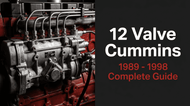
12 Valve Cummins (1989-1998): The Legend, the Specs, the Build Path
Posted by Diesel Power Source on May 08, 2026
The 12 valve Cummins is the engine that built the Dodge diesel reputation. Built from 1989 through 1998 in two distinct versions - the 1st gen (1989-1993) and the 2nd gen (1994-1998) - the 12V is fully mechanical, electronically uncomplicated, and structurally one of the strongest diesel engines ever installed in a pickup truck. Three decades after the first one rolled off the line, 12V Cummins trucks are still daily-driven, still towing, and still being built into 1,000+ horsepower performance machines.
This guide covers everything about the 12 valve Cummins: specifications, the differences between 1st gen and 2nd gen, common problems and how to address them, horsepower limits, and the upgrade paths that work.
What Is a 12 Valve Cummins?
The 12 valve Cummins is the first generation of the 5.9L Cummins inline-six diesel installed in Dodge Ram pickup trucks. The "12 valve" name refers to the cylinder head - two valves per cylinder (one intake, one exhaust), totaling 12 valves across the six cylinders. This was the original head design before the 24-valve update in mid-1998.
The 12V era ran from 1989 through mid-1998 and is also called the "B-series" or "5.9 Cummins B" engine. It was the first Cummins diesel installed in a Dodge pickup truck (1989) and is widely credited with launching the modern American light-duty diesel truck market. The 12V was followed by the 24 valve Cummins in mid-1998.
1st Gen vs 2nd Gen 12 Valve - The Critical Difference
The 12V era covers two meaningfully different versions, and understanding which one you have matters for everything from upgrades to value.
1st Gen 12V (1989-1993)
The 1989-1993 12V Cummins used the Bosch VE rotary injection pump - a smaller, simpler mechanical pump good for around 160-185 HP from the factory. These trucks have the classic boxy first-generation Dodge Ram body style. They came in two-wheel-drive and four-wheel-drive configurations, regular cab and club cab. The intercooler was added in 1991, so 1989-1990 trucks are non-intercooled and slightly less powerful.
The VE pump has horsepower limits - it can be modified for moderate gains (250-300 HP range) but isn’t the basis for high-horsepower builds. Most serious 1st gen performance builds replace the VE pump with a P7100 from a 2nd gen truck, which opens up significantly more power potential.
2nd Gen 12V (1994-1998)
The 1994-1998 12V Cummins is the engine that made the platform legendary. Cummins replaced the VE pump with the Bosch P7100 inline injection pump (commonly called the "P-pump") - a much larger, mechanically simpler, and dramatically more capable pump. The P7100 became the foundation for thousands of high-horsepower 12V builds because it can be modified, upgraded, and tuned in ways the VE pump simply cannot match.
The 2nd gen body style is also different - longer, more refined, with a different grille and updated interior. Factory power increased to 215-235 HP through the production run. By the end of the 2nd gen 12V era in 1998, Cummins had a proven, established platform that the diesel performance industry was built on.
Quick Reference
- 1st Gen 12V (1989-1993): Bosch VE rotary pump, 160-185 HP factory, intercooler added 1991, classic boxy body
- 2nd Gen 12V (1994-1998): Bosch P7100 inline pump, 215-235 HP factory, the high-horsepower foundation, refined body style
12 Valve Cummins Specifications
Here are the key specs for the 12V Cummins as installed in factory Dodge Ram trucks:
- Engine code: 6BT 5.9L (359 cubic inches)
- Configuration: Inline six-cylinder, turbocharged (intercooled from 1991+)
- Bore x Stroke: 4.02 in x 4.72 in (102 mm x 120 mm)
- Compression ratio: 17.0:1
- Cylinder head: 12-valve (2 valves per cylinder)
- Fuel system (1989-1993): Bosch VE rotary injection pump (mechanical)
- Fuel system (1994-1998): Bosch P7100 inline injection pump (mechanical)
- Factory turbocharger: Holset HX35W (most years), HX35 on earlier trucks
- Factory horsepower: 160-235 HP at the crank (varies by year)
- Factory torque: 400-460 lb-ft at the crank (varies by year)
- Block: Cast iron, deep-skirt design
- Crankshaft: Forged steel
- Connecting rods: Forged steel - the strongest stock rods in any modern Cummins
Which Trucks Got the 12 Valve Cummins?
The 12V Cummins was installed in Dodge Ram pickup trucks built from 1989 through mid-1998:
- 1989-1993 Dodge Ram 250/350 (1989-1993): 1st gen body with Bosch VE pump
- 1994-1998 Dodge Ram 2500/3500 (1994-1998): 2nd gen body with Bosch P7100 pump
Cab configurations included regular cab, club cab, and quad cab (added in 1998). Both 2WD and 4WD were available throughout the production run. The 12V was replaced mid-1998 by the 24V Cummins, which kept the 5.9L block but added a four-valve head and electronic VP44 injection pump.
Common 12 Valve Cummins Problems
The 12V Cummins is one of the most reliable diesel engines ever produced. Many trucks have crossed 500,000-1,000,000 miles in original condition. But every platform has known issues, and these are the ones to watch for.
Killer Dowel Pin (KDP)
The most well-known 12V issue. There’s a small alignment dowel pin in the front of the engine block that can work loose over time and drop into the timing gear case - potentially destroying the gear train and causing catastrophic engine damage. Almost every 12V owner addresses this preventively. The fix is a simple "KDP tab" that retains the dowel pin permanently. It’s a 30-minute job with the front cover off, and any 12V Cummins that hasn’t had the KDP fix done should be a priority for the next owner.
Cracked Exhaust Manifolds
The factory 12V exhaust manifold is single-piece cast iron and cracks over time from thermal stress. This is universal to any long inline-six diesel manifold. The fix is a multi-piece exhaust manifold designed with expansion joints between the sections. Each section can expand and contract independently as the engine heats and cools, absorbing the thermal stress that cracks single-piece designs. The 12V uses a T3 12V manifold with the rectangular port head pattern (the 24V used a round port pattern - the manifolds are NOT interchangeable between the two engines).
Lift Pump Failure
The factory lift pump is a known weak point on both 1st gen and 2nd gen 12V trucks. Failure causes hard starts, hesitation under load, and eventually a no-start condition. Many owners proactively replace the factory lift pump with an aftermarket high-flow unit (FASS, AirDog, or similar) for both reliability and to support fuel system upgrades when adding power.
VE Pump Issues (1st Gen Only)
The Bosch VE pump used on 1989-1993 12V trucks has its own quirks. Internal seals deteriorate over time, leading to fuel leaks and timing drift. Rebuilds are available but the VE pump is also commonly swapped out entirely for a P7100 from a 2nd gen truck during high-performance builds. For trucks staying near factory power, a properly rebuilt VE pump is fine.
Front Crank Seal Leaks
Front main seal leaks are common on high-mileage 12V engines. Symptoms are oil dripping from behind the harmonic balancer or accumulating on the lower front of the engine. The fix is a front cover reseal, which is also a perfect time to address the KDP if it hasn’t been done.
Rust (Body and Frame)
Not an engine issue but a real concern when buying any 1989-1998 Dodge Ram. Northeast and Midwest trucks often have severe frame and body rust that can be expensive or impossible to fully repair. Inspect carefully, especially around the rear cab corners, rocker panels, bedsides, and frame rails.
How Much Horsepower Can a Stock 12 Valve Cummins Handle?
The factory 12V Cummins has the strongest stock connecting rods of any modern Cummins engine. Real-world data from the diesel performance community shows:
- Stock rod bolts: Approximately 800 RWHP is the reliable street limit
- With ARP rod bolts: Approximately 1,000 RWHP is common for street builds
- Race/competition use: Properly built 12V engines have made 1,400-1,500 HP before bending stock rods, though aftermarket rods become standard at extreme power levels
The factory 12V rods bend rather than snap when overstressed, which gives builders early warning of impending failure rather than catastrophic destruction. This is one of the reasons the 12V remains the favorite platform for high-horsepower builds — the failure mode is forgiving.
That said, several other components need attention before bottom-end work becomes the limiting factor:
- Around 400 RWHP: The factory 47RH/47RE automatic transmission (or stock 5-speed manual) typically needs upgrading or rebuilding for reliability
- Around 500-550 RWHP: The stock fuel system reaches its limit; injector and fuel supply upgrades become necessary
- 45 PSI of boost: Head studs become recommended to keep the head sealed
- 55 PSI of boost: Fire rings or O-rings become recommended in addition to head studs
The transmission is almost always the first major component to need attention as power increases. The 12V engine itself is rarely the limiting factor on a well-built truck under 800 RWHP.
Performance Upgrade Paths for the 12 Valve Cummins
The 12V Cummins responds beautifully to upgrades because of its mechanical simplicity and structural strength. Here are the upgrade paths that actually deliver results, organized by power level and goal.
Daily Driver and Light Towing (Stock to ~350 RWHP)
Goals at this level are usually about extending engine life, dropping EGTs, improving towing performance, and adding modest power without changing the truck’s daily character. Recommended path:
- High-flow aftermarket lift pump - Cheap insurance against the known weak lift pump and supports any future fuel upgrades
- Fuel pressure gauge - Monitors lift pump health
- Pyrometer (EGT gauge) - Essential for any modified diesel
- 4" exhaust system - Drops EGTs and frees up the turbo
- Fuel plate (2nd gen P7100 only) - Mechanical adjustment that adds 50-75 HP, bolt-on simplicity
- Turbo wheel upgrade or stock-replacement upgraded turbo - Often a 60-62mm wheel for noticeable gains over factory
Performance and Heavy Towing (350-600 RWHP)
This is where the 12V really comes alive as a balanced performance build. Most enthusiasts targeting daily-drivable power with strong towing capability land in this range. Recommended path:
- Single S300-platform turbo upgrade - A properly sized S300 (62mm to 66mm compressor) delivers strong response with significant top-end gains over factory
- Built or upgraded transmission - Required to handle the extra torque
- Fuel system upgrade - Larger injectors, P7100 modifications (delivery valves, governor spring, fuel plate)
- Multi-piece performance exhaust manifold - Crack-resistant, higher flow, lower drive pressure
- Head studs - Once you cross 45 PSI of boost
At this level, a single turbo upgrade from the S300 family is the most common choice. Sizing matters — an S362 or S363 spools quickly and works great for towing-focused builds, while an S366 or S369 makes more top-end power for performance-focused builds.
Compound Turbo Builds (500-1,200+ RWHP)
Compound turbo kits are the next step beyond single turbo upgrades. A compound system pairs a smaller high-pressure turbo with a larger atmospheric turbo, splitting the workload across two stages of compression. The result is faster spool than a single turbo of equivalent flow capacity, EGT reductions of 200-400°F under load, and a wider usable powerband from idle to redline.
Compound kits aren’t just for high-horsepower builds. Many 12V owners run compound setups on stock fueling because the system improves combustion efficiency, drops EGTs, and tows better even without added power. The compound advantage isn’t just "more power" - it’s the engine working the way it was designed to.
For 12V Cummins applications, compound kit options scale from entry-level (S362/S363 over S475 for builds under 550 RWHP) up through serious performance configurations (S366 or S369 over S480 for 700+ RWHP). The kits include both turbos, a 2G center-mount 12V manifold (which uses the rectangular port pattern specific to 12V engines), all piping, oil lines, and hardware. Browse the full 12V Cummins compound kit lineup.
P7100 Pump Modifications (2nd Gen 12V Only)
Among diesel performance enthusiasts, the Bosch P7100 inline pump is legendary for how much horsepower it can support with the right modifications. Common P-pump upgrades include:
- Fuel plate - Mechanical adjustment that increases fuel delivery, adds 50-100 HP
- Delivery valves - Aftermarket valves that improve injection characteristics, often paired with larger injectors
- Governor spring kit - Allows the pump to safely operate at higher RPM
- Fuel plate cut to 100/100/100 or beyond - Stage 3+ modifications for high-horsepower builds
- 10mm or 12mm pump conversions - Larger plunger and barrel sets for race-level builds
P-pump modifications are mechanical - no electronic tuning involved. This is one of the major appeals of the 12V platform: power gains come from physical adjustments to the fuel pump rather than software, which makes them durable and predictable.
Exhaust Manifold Upgrade (Recommended for All Power Levels)
The factory exhaust manifold on the 12V Cummins is a single-piece cast iron unit that cracks over time from thermal stress. The fix is a multi-piece exhaust manifold with expansion joints between sections. The 12V specifically uses a T3 12V manifold with the rectangular port head pattern (12V and 24V manifolds are NOT interchangeable due to the different head port shapes).
This upgrade benefits every 12V Cummins regardless of power level. Even a stock truck benefits from a manifold that won’t crack. Browse the 5.9 Cummins exhaust manifold lineup for 12V T3 options.
Buying a Used 12 Valve Cummins Truck — What to Check
If you’re shopping for a used 1989-1998 Dodge Ram with the 12V Cummins, here’s a focused inspection checklist:
- KDP fix. Has the killer dowel pin been addressed? If unknown, budget for the fix as a priority maintenance item.
- Frame and body rust. 1989-1998 Dodge Rams in salt-belt states have known rust issues. Inspect cab corners, rocker panels, bedsides, frame rails, and fuel tank straps thoroughly.
- P7100 pump (1994-1998). Listen for unusual ticking or knocking. Check for fuel leaks around the pump body and lines. A healthy P7100 will run for hundreds of thousands of additional miles with basic maintenance.
- VE pump (1989-1993). Check for fuel leaks, irregular timing, and rough running. Consider whether you want to keep the VE or eventually swap to a P7100.
- Lift pump. Check for replacement history. Factory lift pumps fail; aftermarket replacements are common.
- Exhaust manifold cracks. Look for soot trails along the manifold-to-head sealing surface and listen for ticking on cold start that fades as the engine warms.
- Transmission condition. The factory automatic (47RH/47RE) and the early manual transmissions have known weaknesses. Ask about service history.
- Front-end wear items. Steering boxes, ball joints, and track bars wear out on heavy 4x4 trucks. Budget for these on any 30+ year old Ram.
- Maintenance records. A 12V Cummins with documented oil changes and basic care will outlast a much newer truck without that history.
Why the 12 Valve Cummins Still Matters in 2026
The 12V Cummins remains one of the most desirable diesel platforms in the world for several reasons. The combination of mechanical simplicity (no electronics in the fuel system, no DPF, no DEF, no EGR, no emissions equipment), the strongest factory rotating assembly Cummins ever produced, and the kind of fuel pump tunability that opened the door to massive horsepower with mechanical modifications makes it the gold standard for builders who want simple, durable, and capable.
Used 1989-1998 Dodge Ram trucks with healthy 12V Cummins engines have been gaining value over the past decade as the supply of clean examples shrinks. Aftermarket support is mature and deep, parts are widely available, and the engine itself is genuinely tunable through mechanical means that don’t require electronics or tuning software. For someone building a daily-driven performance truck, a tow rig, a sled puller, or a high-horsepower play truck, the 12V remains the platform of choice.
At Diesel Power Source, we manufacture compound turbo kits, single turbo upgrades, and multi-piece exhaust manifolds specifically engineered for the 12V Cummins. Every product is designed in our Utah facility, CFD-tested for flow optimization, and supported by the engineers who built it. Browse the full 1st gen 12V parts lineup (1988-1993), the 2nd gen 12V parts lineup (1994-1998), or visit our 5.9 Cummins category hub for everything that fits the 1989-2007 5.9 platform.
Frequently Asked Questions
What years did the 12 valve Cummins come out?
The 12 valve Cummins was installed in Dodge Ram pickup trucks from 1989 through mid-1998. The 1st gen 12V (1989-1993) used the Bosch VE rotary injection pump and the classic boxy first-generation Dodge body. The 2nd gen 12V (1994-1998) used the legendary Bosch P7100 inline injection pump and the second-generation body style. The 12V was replaced mid-1998 by the 24 valve Cummins, which kept the 5.9L block but added a four-valve head and electronic VP44 injection pump.
What is the difference between a 1st gen and 2nd gen 12 valve Cummins?
The major difference is the fuel injection pump. The 1st gen 12V (1989-1993) uses the Bosch VE rotary pump, which is smaller and limits horsepower potential to roughly 250-300 HP without major modifications. The 2nd gen 12V (1994-1998) uses the Bosch P7100 inline pump, which can be modified to support 1,000+ HP and is the foundation for serious performance builds. Body style is also different — 1st gen has the classic boxy body, 2nd gen has a more refined longer body. Factory power increased from 160-185 HP (1st gen) to 215-235 HP (2nd gen).
How reliable is the 12 valve Cummins?
The 12 valve Cummins is one of the most reliable diesel engines ever produced. Many examples have crossed 500,000 to 1,000,000 miles in original condition. The fully mechanical fuel system has no electronics to fail, the rotating assembly is the strongest in any modern Cummins, and the engine has no emissions equipment to malfunction. Known weak points are addressable: the killer dowel pin (preventive fix is simple), the factory lift pump (easy aftermarket replacement), the factory exhaust manifold (multi-piece replacement available), and on 1st gen trucks the VE pump (rebuildable or replaceable). Outside of basic preventive maintenance, the 12V is exceptional.
How much horsepower can a 12 valve Cummins make?
Factory horsepower ranged from 160 HP (1989-1990 non-intercooled) to 235 HP (1998 P7100 trucks). The factory bottom end can reliably handle approximately 800 RWHP on stock rod bolts, approximately 1,000 RWHP with ARP rod bolts, and properly built engines have produced 1,400-1,500 HP before stock rods bend. The 12V is the favorite platform for high-horsepower diesel builds because the rotating assembly is forgivingly strong.
What is the killer dowel pin on a 12 valve Cummins?
The "killer dowel pin" (KDP) is a small alignment dowel pin in the front of the engine block that can work loose over time and drop into the timing gear case, potentially destroying the gear train and causing major engine damage. It’s a known issue across all 12V Cummins engines and most owners address it preventively with a simple "KDP tab" that retains the pin permanently. The fix takes about 30 minutes with the front cover off and is one of the most common 12V maintenance items. Any 12V Cummins that hasn’t had the KDP fix done should be a priority for the next owner.