6.7 Cummins Turbo Upgrade Guide: 4 Paths from Drop-In to 1,200+ HP
Posted by Diesel Power Source on May 11, 2026
The 6.7 Cummins is one of the most upgraded diesel engines on the road, and the turbo is almost always the first major upgrade owners make. Whether you’re trying to fix a failing factory VGT, drop EGTs while towing, add power for a daily driver, or build a high-horsepower competition truck, the turbo upgrade path you choose determines how the truck performs for the next decade.
This guide covers every realistic 6.7 Cummins turbo upgrade option from 2007.5 through 2024. We’ll look at what the factory turbos do, why they fail, the four main upgrade paths, how to choose between them, and what supporting modifications you’ll need at each power level.
Understanding the Factory 6.7 Cummins Turbo
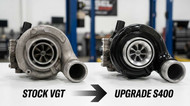
The 6.7 Cummins uses a Holset variable geometry turbocharger (VGT) from the factory across all model years. The VGT has electronically controlled vanes inside the turbine housing that change the effective A/R ratio based on engine load and RPM, giving the turbo broad efficiency from idle to full throttle while also providing exhaust braking capability.
The factory turbo varies by year:
- 2007.5-2012 Ram 6.7L Cummins: Holset HE351VE VGT
- 2013-2018 Ram 6.7L Cummins: Holset HE300VG VGT
- 2019-2024 Ram 6.7L Cummins: Holset HE300VG VGT (5th gen platform with proprietary lower-mount flange)
The factory turbos work well at stock power levels. They’re responsive, support the factory exhaust brake, and integrate with the truck’s emissions system. But they have well-documented failure points that drive most 6.7 Cummins owners toward an upgrade eventually.
Why the Factory 6.7 Cummins Turbo Fails
The factory VGT system has several known failure modes:
Sticking Vanes
The variable vanes inside the turbine housing are exposed to soot buildup from the diesel exhaust. Over time, the soot accumulates and prevents the vanes from moving freely. The result: loss of boost control, sluggish throttle response, and eventually limp mode.
Actuator Failure
The electronic actuator that controls vane position is a known weak point. When it fails, the truck typically throws codes including P003A (turbocharger boost control position not learned), P2262 (turbocharger boost pressure not detected), P00AF (turbocharger boost control "A" module performance), and P0299 (turbocharger underboost condition).
Bearing Failure
Factory turbo bearings wear out over time, especially on trucks that have been heavily worked, run hot, or had inadequate oil changes. Bearing failure typically causes excessive shaft play, oil consumption through the seals, and eventually catastrophic turbo failure.
Cost of Replacement
A factory replacement HE351VE or HE300VG VGT runs $2,500-$4,000 installed. And replacing a factory VGT with another factory VGT just restarts the failure clock. This is the calculus that drives most 6.7 owners toward an upgraded turbo: if you’re already spending the money, why not get something better, more reliable, and more powerful?
The Four Main 6.7 Cummins Turbo Upgrade Paths
Every 6.7 Cummins turbo upgrade falls into one of four categories. Each has its place. The right choice depends on your power goal, your emissions situation, and your budget.
Path 1: Stock-Replacement VGT Upgrade (Drop-In)
Replaces the factory turbo with an upgraded HE-series VGT that bolts in like an OEM unit. The upgrade typically uses a larger compressor wheel and turbine wheel for better airflow and lower EGTs while keeping all factory connections, factory exhaust brake function, and emissions equipment intact.
Common configurations:
- HE363VG (DPS upgrade): 63mm compressor (up from factory 60mm) — supports up to ~500 RWHP
- HE366VG (DPS upgrade): 66mm compressor — supports up to ~550 RWHP
The DPS upgrade also includes a larger turbine wheel for better exhaust flow. The Holset platform names everything "HE300VG" regardless of internal wheel size, but the DPS extended naming convention indicates the actual wheel diameter in millimeters.
Best for: Owners who want a clean factory-style upgrade, want to keep emissions equipment intact, want to retain the factory exhaust brake, and want modest power gains (typically 30-40 HP improvement and noticeably cooler EGTs).
Limitations: Same fundamental architecture as the factory VGT, so similar failure modes (vane sticking, actuator wear) apply over time, just at slightly improved performance levels. Browse the HE300VG replacement turbo options.
Path 2: Add-A-Turbo Compound Kit (Stocker Compound)
Keeps the factory turbo and adds a much larger atmospheric turbo in front of it, creating a compound system where the new larger turbo "turbocharges" the factory turbo. The factory VGT becomes the high-pressure (small) stage, and the added S400-platform turbo becomes the low-pressure (large) stage.
This is the only compound kit that retains all factory emissions equipment. The factory exhaust manifold stays in place, the factory EGR connection works, the factory exhaust brake works, and the truck remains emissions-compliant.
The standard atmospheric turbo for most builds is an S475/96/1.32 (75mm compressor). For trucks pushing higher power (600+ RWHP), the S480/96/1.32 (80mm compressor) is the recommended upgrade.
On 2010-2018 trucks, DPS uses a patented cast hot pipe — a single casting that routes all exhaust from the factory turbo outlet to the atmospheric turbo and back to the factory exhaust connection through one piece. This eliminates the cracking issues common with welded multi-piece hot pipes used by other manufacturers.
Best for: Owners who want compound turbo benefits (200-400°F EGT reduction, dramatically improved towing, better combustion efficiency) without giving up factory emissions equipment, factory exhaust brake, or daily-driver behavior.
Power range: Stock fueling up to ~600 RWHP (with S475), ~700 RWHP (with S480 upgrade).
Limitations: Still relies on the factory turbo as the small stage, so factory VGT failure modes still apply over time. Browse the add-a-turbo compound kit.
Path 3: 3rd Gen Swap Kit (S300 Conversion)
Removes the factory VGT entirely and replaces it with a fixed-geometry S300 turbo and DPS multi-piece exhaust manifold. The new turbo stays in the factory location and bolts to factory exhaust, intake, and intercooler connections. No custom piping required.
This is the cleanest way to permanently eliminate VGT-related problems. There’s no electronic actuator, no movable vanes, and no boost control sensor to fail. The S300 turbo is fundamentally simpler and more durable than any VGT.
Available in multiple turbo configurations:
- S363/73/.80: 530 RWHP capable, fastest spool, daily/tow focused
- S366/73/.80: 650 RWHP capable, popular performance build
- S369/73/.80: 775 RWHP capable, higher power applications
- S400 VGT options: Up to 1,000 RWHP with variable geometry and exhaust braking
An optional Turbonator® VGT upgrade adds variable geometry and exhaust braking to the S300 platform — combining the simplicity of fixed-geometry mechanical reliability with VGT-style spool and exhaust brake function.
Best for: Trucks already deleted (no emissions equipment), owners experiencing repeated VGT failures, builders targeting 530-1,000 RWHP, anyone who wants a permanent fix to P003A-class problems. Browse the 3rd Gen Swap Kit options.
Limitations: Designed for trucks that have already been deleted. The factory exhaust brake function requires the optional Turbonator® VGT upgrade.
Path 4: Full Compound Turbo Kit
The biggest possible upgrade. Replaces both the factory turbo and exhaust manifold with a complete compound system: a smaller high-pressure S300 turbo plus a larger atmospheric S400 turbo, paired with a 2nd gen-style center-mount manifold, all piping, oil lines, and supporting hardware.
This delivers the largest power potential, the lowest EGTs, and the best combustion efficiency of any 6.7 Cummins turbo upgrade. Many owners run compound kits even on stock fueling because the system fundamentally changes how the engine breathes — EGTs drop 200-400°F under load, towing capability improves dramatically, and fuel mileage often improves because combustion is more complete.
Common compound configurations for 6.7 Cummins:
- S363/73/.80 over S475/96/1.32: Entry-level 6.7 compound, up to ~650 HP
- S363/73/.80 over S480/96/1.32: Towing + moderate performance, up to ~700 HP
- S366/73/.80 over S480/96/1.32: Performance builds, up to ~1,000 HP
- S369/73/.80 over S480/96/1.32: High performance, 1,000+ HP capable
Best for: Maximum performance, heavy towing, builds targeting 600+ RWHP, racing/competition applications, owners who want the biggest possible reduction in EGTs.
Power range: 500 RWHP up to 1,200+ RWHP depending on configuration. Browse the 6.7 Cummins compound turbo kit lineup.
Limitations: Designed for trucks that have already been deleted. More involved installation than other upgrade paths. Higher upfront cost, but delivers the biggest performance and EGT improvement available.
How to Choose the Right 6.7 Cummins Turbo Upgrade
Use this decision framework to narrow down which path fits your situation:
Question 1: Is your truck deleted or emissions-intact?
This is the first filter. If your truck retains factory emissions equipment (EGR, DPF, DEF, factory exhaust brake), your only options are Path 1 (stock-replacement VGT) or Path 2 (add-a-turbo compound). The 3rd Gen Swap Kit and full compound kit both require the factory VGT and emissions hardware to be removed.
Question 2: What’s your power target?
- Stock to 500 RWHP: Path 1 (stock-replacement VGT upgrade) is enough
- Stock to 700 RWHP: Path 2 (add-a-turbo compound) handles this range with emissions intact
- 500 to 800 RWHP: Path 3 (3rd Gen Swap Kit) is the cleanest single-turbo solution
- 600 to 1,200+ RWHP: Path 4 (full compound kit) is the only realistic option
Question 3: How much do you tow?
Heavy towing is where compound systems really shine. The 200-400°F EGT reduction protects the engine, the wider powerband makes pulling grades easier, and combustion efficiency improvements often deliver better fuel mileage under load. If you tow heavy regularly:
- Emissions-intact: Path 2 (add-a-turbo compound) is purpose-built for this
- Deleted: Path 4 (full compound kit) is the optimal towing setup
If you don’t tow at all and just want power, a single-turbo upgrade (Path 1 or Path 3) might be the cleaner answer.
Question 4: What’s your VGT failure history?
If you’ve already replaced the factory VGT once or twice and are tired of the cycle, lean toward Path 3 (3rd Gen Swap Kit) or Path 4 (full compound kit). Both eliminate the factory VGT entirely. P003A, P2262, P00AF, and P0299 codes all become a thing of the past.
Question 5: What’s your budget?
Roughly speaking, in increasing order of investment:
- Stock-replacement VGT upgrade (Path 1) — least expensive
- Add-a-turbo compound (Path 2) — mid-range, only one new turbo
- 3rd Gen Swap Kit (Path 3) — mid-range, complete swap
- Full compound kit (Path 4) — highest investment, biggest performance return
Supporting Modifications You’ll Need
Turbos don’t exist in isolation. As power increases, supporting components need attention. Here are the practical thresholds:
Around 400 RWHP — Transmission
The factory 68RFE automatic transmission is the first major component to need attention as power rises. Stock 68RFEs often start having issues around 400 RWHP under load (towing, heavy throttle). Built or upgraded transmissions become standard at this level. The transmission is almost always the limiting factor before the engine itself.
Around 500-550 RWHP — Fuel System
Stock fuel systems on the 6.7 Cummins reach their limit around 500-550 RWHP. Upgrades typically include larger injectors, an upgraded CP3 pump (or dual-pump setup), and improved fuel supply (lift pump). Without these upgrades, you’ll hit a fueling ceiling regardless of how much air the turbo can deliver.
48 PSI Boost — Head Studs
The 6.7 Cummins factory head bolts hold up well under stock boost levels but become inadequate above approximately 48 PSI. ARP head studs are standard practice once compound systems and high-boost setups are involved.
55 PSI Boost — Fire Rings or O-Rings
For trucks targeting compound power levels above 55 PSI, fire rings or O-rings in the head become recommended for reliable head sealing. This is engine-out work, but if you’re already pulling the head for studs, it’s the smart time to add fire rings as well.
600-800 RWHP — Connecting Rods
The 6.7 Cummins uses fractured-cap connecting rods that snap rather than bend when overloaded. Safe and reliable street use is approximately 600-750 RWHP. Above 800 RWHP, aftermarket rods become the smart investment for long-term reliability. Above 900 RWHP, they become required.
5th Gen 6.7 Cummins (2019-2024) — What’s Different
The 2019-2024 Ram 6.7 Cummins (5th gen body) uses a proprietary lower-mount turbo flange that’s different from all previous generations. This affects fitment for aftermarket turbo upgrades.
Currently available for 5th gen:
- HE300VG replacement turbo (Path 1 — drop-in stock-replacement upgrade)
- 5th gen exhaust manifold (factory-style replacement)
- 5th gen turbo and manifold kit (matched system)
A full 5th gen compound turbo kit is in development with no firm release date as of this article. 5th gen owners targeting compound performance should contact us for current availability.
Common 6.7 Cummins Turbo Questions
How long does a factory 6.7 Cummins turbo last?
Factory turbo lifespan varies wildly based on usage, maintenance, and luck. Some factory turbos go 200,000+ miles without issues. Others fail at 80,000-120,000 miles with sticking vanes, actuator problems, or bearing failure. The most consistent predictor of factory turbo life is whether the truck sees heavy towing, frequent short trips (which prevent the EGR from regenerating properly), or deferred oil changes. Trucks driven gently with conscientious maintenance generally last longer.
What is the best turbo upgrade for a 6.7 Cummins for towing?
For emissions-intact trucks: the add-a-turbo compound kit. It keeps the factory exhaust brake and EGR while delivering the EGT reduction and wider powerband that compound systems provide. For deleted trucks: a full compound kit is the optimal towing setup. Both compound paths drop EGTs 200-400°F under load, which is the single most important factor for heavy towing reliability.
What turbo do I need for 600 HP on a 6.7 Cummins?
600 RWHP is in the sweet spot where multiple paths work. An add-a-turbo compound with the S480 atmospheric upgrade hits this range while keeping emissions equipment. A 3rd Gen Swap Kit with an S366 also lands here for deleted trucks. A full compound kit with an S363/73/.80 over S475/96/1.32 covers this with room to grow. Choice depends on your emissions situation, towing needs, and whether you want headroom for future power increases.
Will an upgraded turbo void my warranty?
Aftermarket turbo upgrades will void the factory powertrain warranty on the affected components. If your truck is still under factory warranty and the warranty matters to you, that’s a real consideration. For trucks out of warranty, this is no longer a factor. Diesel Power Source provides our own warranty on our turbo upgrades — see warranty paperwork for specific terms.
Do I need a tuner with a turbo upgrade?
For Path 1 (stock-replacement VGT) on emissions-intact trucks: no, the factory ECM handles the larger turbo without retuning, though some owners choose to add a mild tune for additional gains. For Paths 2, 3, and 4 (any compound or swap kit): a custom tune matched to the specific build is generally recommended for optimal performance, especially as power levels increase. Tuning isn’t included with our turbo kits — work with a reputable Cummins tuner experienced in your specific build configuration.
Why Diesel Power Source Turbos
At Diesel Power Source we manufacture turbo upgrades and complete turbo systems specifically for the 6.7 Cummins from 2007.5 through 2024. Every turbo we build is based on the proven Holset HE-series or BorgWarner S-series platform, then engineered by our staff to outperform the platform we started with.
Every product is designed in our Utah facility, CFD-tested for flow optimization and EGT reduction, and supported by the engineers who built it. We don’t resell other manufacturers’ products. We make the turbos, manifolds, hot pipes, and complete kits we sell.
Browse the full 6.7 Cummins parts lineup, the HE300VG replacement turbo options, the add-a-turbo compound kit, the 3rd Gen Swap Kit, or the full 6.7 compound turbo kit. If you’re unsure which upgrade path fits your truck and goals, call us at 801-930-8404 or email sales@dieselpowersource.com.