Compound Turbos for Cummins: The Complete Guide (5.9 & 6.7)
Posted by Diesel Power Source on May 15, 2026
If you own a Cummins diesel and you’ve been looking into turbo upgrades, you’ve almost certainly run into compound turbo kits. Maybe you’ve seen them in forum threads, on YouTube install videos, or in conversations at the diesel shop. The question most people ask is the same: what do compounds actually do, and do I really need them?
This guide answers that question completely. We’ll cover what a compound turbo system is, how it works mechanically, what it actually does to the engine, the four big advantages that have made compounds the default upgrade path for serious Cummins builds, and honest guidance on when a compound kit is right for your truck and when a single turbo is the smarter choice.
What Is a Compound Turbo System?
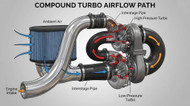
A compound turbo system uses two turbochargers working together in series to compress intake air, instead of one turbo working alone. The smaller turbo (called the high-pressure or primary turbo) sits closest to the engine. The larger turbo (called the atmospheric or secondary turbo) sits further upstream and feeds the smaller turbo. Air flows from the atmosphere into the large turbo, gets compressed once, then flows into the small turbo and gets compressed a second time before entering the engine’s intercooler and intake.
The terms "compound turbo" and "twin turbo" are sometimes used interchangeably in the diesel world, but they aren’t the same thing. A compound system runs the two turbos in series — one feeding the other. A traditional twin turbo runs both turbos in parallel, each feeding its own bank of cylinders. On a Cummins inline-six, compounds make far more sense than parallel twins because of the engine architecture.
Compound turbo kits aren’t a new technology — they’ve been used in heavy-duty diesel applications, locomotives, and high-output industrial engines for decades. What’s changed is that they’re now well-engineered, properly sized, and packaged as bolt-on kits for Cummins pickup trucks. That’s why compound kits have become the default upgrade path for owners targeting serious power, serious towing capability, or both.
How Compound Turbos Actually Work
The mechanical principle of a compound turbo system is straightforward, but the implications for engine performance are significant. Here’s the full picture.
Air Flow Path
Atmospheric air enters the large turbo’s compressor inlet, gets compressed and warmed up, exits the large turbo’s compressor outlet, flows through piping into the small turbo’s compressor inlet, gets compressed a second time (and warmed up further), exits the small turbo’s compressor outlet, flows through the intercooler where it cools down significantly, then enters the engine intake manifold at the boost pressure and temperature the engine needs.
Exhaust Flow Path
Hot exhaust gas leaves the cylinder head, enters the exhaust manifold, flows through the small turbo’s turbine first (the small turbo spins up easily on the high-velocity exhaust right out of the head), then flows into the large turbo’s turbine through a hot pipe connecting the two, and finally exits to the downpipe and exhaust system.
What Makes This Different from a Single Turbo
On a single turbo, one turbocharger does all the work — it has to spool fast enough at low RPM AND flow enough air at high RPM. These two requirements pull turbo sizing in opposite directions. A small turbo spools fast but runs out of breath at high RPM. A large turbo flows great at high RPM but lags badly at low RPM. The traditional single-turbo tradeoff is choosing which compromise to live with.
Compound systems eliminate that tradeoff. The small turbo handles low-RPM spool because it’s small enough to spin up easily on the limited exhaust energy available at low engine speeds. The large turbo handles high-RPM flow because it’s sized to handle the volume of air the engine needs at full load. Together they cover both ends of the operating range without compromise.
The result is what diesel enthusiasts often describe as "more usable powerband." Spool comes in earlier, peak power lasts longer, and the engine pulls hard from idle to redline rather than feeling soft on either end.
The Four Real Advantages of Compound Turbos
Most compound turbo discussions focus on horsepower numbers. Horsepower is part of the story, but it’s not the most important part. Here are the four advantages compound systems actually deliver, in order of how much they matter day to day.
Advantage 1: 200-400 Degree EGT Reduction Under Load
This is the big one. Compound turbo systems typically reduce exhaust gas temperatures by 200 to 400 degrees Fahrenheit under load compared to a single turbo of equivalent power output. There are two mechanisms working together to produce this reduction.
First, more complete combustion. Compound systems push enough air into the cylinder that fuel burns more completely — meaning more of the fuel’s chemical energy gets converted to mechanical power inside the cylinder rather than being wasted as unburned hydrocarbons exiting the exhaust as heat. When combustion is more efficient, less energy leaves the engine as exhaust heat. EGTs drop.
Second, excess air molecules absorb heat. The air molecules that compound systems push into the cylinder that are NOT consumed during combustion still absorb heat from the cylinder walls and combustion gases, then carry that heat out the exhaust as warm air rather than as superheated gas. This is essentially an internal cooling effect that single-turbo systems can’t replicate to the same degree.
The practical impact: a truck towing heavy with EGTs running 1,400-1,500 degrees under sustained load on a single turbo will often run 1,000-1,200 degrees on a properly sized compound kit pulling the same load. That difference is the gap between "you need to back off the throttle before something melts" and "keep pulling, the truck’s fine."
Advantage 2: Improved Combustion Efficiency and Fuel Mileage
The same complete-combustion physics that drops EGTs also tends to improve fuel mileage. When the engine burns fuel more efficiently, it extracts more usable power from each drop of diesel. That means less fuel needed to produce the same amount of work.
Honest framing here: don’t expect dramatic mileage improvements just from adding compounds. Real-world results vary based on driving style, load, gearing, and supporting modifications. But improvements of 1-3 MPG under towing conditions are common and well-documented. Some owners see more, some see less. The improvement is real but should not be the primary reason to install a compound kit.
Advantage 3: Wider Usable Powerband (Idle to Redline)
Compound systems deliver responsive power across a much wider RPM range than equivalent single-turbo setups. Spool-up happens earlier in the RPM range because the small turbo doesn’t need much exhaust energy to start producing boost. Peak power extends further into the higher RPM range because the large turbo has plenty of flow capacity remaining when the small turbo would normally start running out of breath.
For towing, this means usable boost from just above idle, strong pulling power through the working RPM range, and no flat spots when the truck needs to hold high RPM up a long grade. For daily driving, this means snappy throttle response and a truck that feels like it has more power than the dyno number alone would suggest.
Advantage 4: Intake-to-Exhaust Pressure Ratio of 1:1 or Better
This one is more technical but worth understanding. Every piston engine fights itself in a way: while the intake stroke is bringing air in, the exhaust stroke is pushing out spent gases through a turbocharger that’s creating backpressure against the engine. The ratio between intake boost pressure and exhaust drive pressure determines how efficiently the engine converts fuel into power.
On most stock and single-turbo setups, exhaust drive pressure is higher than intake boost pressure — sometimes substantially higher. This means the engine is fighting itself harder than it has to. On a properly sized compound system, intake boost pressure and exhaust drive pressure are typically 1:1 or better, meaning the intake stroke is actually creating power that balances what the exhaust stroke is robbing from the engine.
The practical effect: the engine works more efficiently, makes more power per unit of fuel, and stays cooler under sustained load. This isn’t marketing language — it’s the physics that explains why compound-equipped trucks consistently outperform single-turbo trucks of equivalent power on real-world towing tasks.
Compound Turbo Sizing for Cummins Applications
The sizing of the two turbos in a compound system matters more than almost anything else about the kit. Get sizing right and the system delivers everything described above. Get sizing wrong — particularly oversize the small turbo — and the truck feels lazy until it’s already moving fast.
How Small Turbo Sizing Affects the Build
The small turbo is the spool turbo. Its job is to come on boost early and hand off cleanly to the large turbo as RPM climbs. The smaller the high-pressure turbo, the earlier the system spools and the more responsive the truck feels at low RPM. The larger the high-pressure turbo, the higher the peak power potential — but spool moves later in the RPM range.
For most builds, a 62mm to 66mm S300 turbo is the right size for the high-pressure stage. An S362 or S363 spools quickly and works great for towing-focused builds and trucks under 600 RWHP. An S366 or S369 makes more top-end power and pairs well with builds in the 600-800 RWHP range. Beyond 800 RWHP, sizing becomes more specialized and depends on supporting modifications.
How Large Turbo Sizing Affects the Build
The large turbo is the flow turbo. Its job is to keep the system breathing as RPM climbs and power demand increases. The larger the atmospheric turbo, the higher the peak power capability. Common large-turbo choices for Cummins compound kits include the S475 (75mm compressor, supports up to ~625 RWHP through the system), S480 (80mm compressor, supports up to ~800 RWHP through the system), and S488 (88mm compressor, used in serious high-power and semi truck applications).
Common Pairings That Work Well
For 5.9L Cummins applications, the popular compound combinations are:
- S362 or S363 over S475 — Entry-level compound. Quick spool, great towing, supports up to 600 RWHP. Excellent daily driver / tow rig setup.
- S363 over S480 — Slight increase in top-end capability while keeping responsive spool. Up to ~700 RWHP.
- S366 over S480 — Performance-focused build. Up to ~1,000 RWHP with supporting modifications.
- S369 over S480 — High-performance build. 1,000+ RWHP capable.
For 6.7L Cummins applications, the same combinations work but you typically start one step larger because the 6.7L has roughly 13% more displacement than the 5.9L. The entry-level 6.7L compound starts with an S363 over S475, which delivers similar spool characteristics to the S362 over S475 on a 5.9L.
Browse the full lineup of Cummins compound turbo kits for current configurations available on the 5.9L, 6.7L, and ISX/X15 applications.
When a Compound Kit Is the Right Choice
Compounds aren’t the right answer for every truck or every owner. Here’s honest guidance on when they make sense.
You Tow Heavy Loads Regularly
This is the strongest case for compounds. Heavy towing creates sustained high EGTs, demands wide usable power, and rewards engines that combust efficiently under load. Compounds deliver all three. If you tow 14,000+ pounds regularly — gooseneck trailers, fifth wheels, equipment trailers, or commercial loads — a properly sized compound kit will protect the engine, improve performance, and often improve fuel economy under load. The investment pays back in reduced EGT-related wear alone.
You Want Daily-Drivable Power Above 600 RWHP
At power levels above approximately 600 RWHP, single-turbo solutions start forcing tough compromises. The turbo that makes that kind of peak power on a single setup is typically lazy off idle and unpleasant to daily drive. Compound systems eliminate that tradeoff — you get the peak power AND retain street manners. If your power goal is above 600 RWHP AND you want the truck to feel responsive at low RPM, compounds are typically the only realistic answer.
Your EGTs Are a Problem and You Won’t Back Off
Some builds run hot because of how the truck is used — aggressive tuning, heavy fueling, sustained high load. If your EGTs are pushing 1,500+ degrees under load and the alternative is reduced power tuning, a compound kit is the engineering fix. The system drops EGTs by 200-400 degrees on the same fuel and the same load.
You’re Building a Performance Truck and Want Compound Benefits at Modest Power
Many compound kit owners run them on stock or near-stock fueling. The compound advantage isn’t about adding power — it’s about how efficiently the engine operates at whatever power level you’re running. Even on a stock-fueled truck, compounds drop EGTs, improve combustion, and widen the powerband. The truck just runs better.
When a Single Turbo Is the Smarter Choice
To be straight with you: compounds aren’t always the right answer. Here’s when a single turbo upgrade is the better path.
You’re Targeting Under 500 RWHP and Don’t Tow Heavy
At power levels under 500 RWHP without heavy towing demands, a properly sized S300 single turbo delivers most of what a compound kit would deliver, at significantly lower cost and complexity. The EGT and powerband benefits of compounds are real but become more pronounced as power and load increase. For a daily driver targeting 400-500 RWHP, a single S363 or S366 is often the right call.
You Want the Cleanest Possible Engine Bay
Compound systems add a second turbo, additional piping, and a hot pipe connecting the two turbos. The engine bay gets more crowded and more complex. Single turbos keep the bay clean and simple. For some owners, that visual and mechanical simplicity is worth the performance tradeoff. Aesthetics and maintenance access matter.
You Want the Lowest-Cost Path to Modest Power Gains
If budget is the primary constraint and the goal is modest power gains over the factory setup, a single stock-replacement turbo upgrade (like a DPS HE363VG on a 6.7L) delivers 30-40 HP additional plus cooler EGTs at a lower cost than any compound kit. It’s the right answer for budget-conscious owners who don’t need the full compound advantage.
You Want a Simple Future Upgrade Path
If you’re unsure whether you’ll ever push the truck to compound-level power, a single S300 upgrade today preserves the option to add a second turbo later by converting to an add-a-turbo setup. Starting with a wastegated single turbo and converting to compounds later is a real upgrade path, though it does require some planning at the original purchase to spec the turbo correctly for future compound conversion.
Compound Turbo Kit Considerations for Cummins Builds
Before purchasing a compound kit, a few practical considerations to think through.
Emissions Status Matters
Most full compound turbo kits require the truck to be deleted (no factory emissions equipment) because the compound system replaces the factory exhaust manifold and turbo. The exception is the DPS Add-A-Turbo kit, which keeps the factory turbo and exhaust manifold in place and adds only the atmospheric turbo in front. The Add-A-Turbo path is the only compound option that retains factory emissions equipment and exhaust brake function. For trucks that need to keep emissions intact, the DPS Add-A-Turbo Compound Kit is the answer.
Supporting Modifications Are Required at Higher Power Levels
Compounds amplify everything the engine and supporting components are doing. At 400 RWHP, the factory transmission typically needs upgrading. At 500-550 RWHP, the stock fuel system reaches its limit. At 45 PSI of boost, head studs become recommended. At 55+ PSI of boost, fire rings or O-rings join the head studs. At 800 RWHP, aftermarket rods become smart insurance. Compound kits don’t change these thresholds — but they do make it easier to reach them. Plan supporting upgrades alongside the compound kit, not after.
Boost Pressures Run Higher
Compound systems naturally run higher peak boost pressures than single-turbo setups because two stages of compression compound their pressure ratios. A 35 PSI compound system might have the small turbo seeing 25 PSI inlet pressure plus another 25 PSI of compression on top of that. This is normal and expected for compound operation, but it’s why head stud thresholds matter sooner on compound builds. Plan for the boost reality of the platform.
Installation Complexity
Full compound kits are more involved to install than single turbo upgrades. There’s more piping, more connections, and more components to fit and adjust. Most DIY-capable builders can install a compound kit in a long weekend with the right tools, but it’s not a 3-hour swap. Plan accordingly — or have a shop with diesel experience install it.
Frequently Asked Questions
How much horsepower can a compound turbo Cummins make?
Compound turbo Cummins builds reliably produce 500 to 1,200+ RWHP depending on configuration and supporting modifications. Entry-level kits (S362/S363 over S475) support up to 600 RWHP comfortably. Performance kits (S366 over S480) handle 800-1,000 RWHP. High-output builds (S369 over S480 with race-grade fueling and bottom-end work) routinely make 1,200+ RWHP. The compound architecture itself is capable of supporting much higher power than the supporting components on most pickup trucks, which means transmission, fuel system, and bottom-end work usually become the limiting factor before the turbos do.
Do compound turbos hurt fuel economy?
Compound turbos typically improve fuel economy under load because they make combustion more complete — more of the fuel’s energy converts to mechanical power instead of being wasted as exhaust heat. Real-world improvements of 1-3 MPG under towing conditions are common. Empty highway driving may see modest improvements, modest reductions, or no change depending on driving style and gearing. Compounds are not primarily a fuel economy upgrade, but they don’t hurt economy the way many people assume turbos do.
Can you run compound turbos on a stock fuel Cummins?
Yes, and many owners do. The compound advantage isn’t dependent on increased fueling — it’s about how efficiently the engine breathes and combusts at whatever fuel level you’re running. Stock-fueled compound builds typically see EGT reductions of 200+ degrees, modest power gains from improved combustion efficiency, and significantly better towing behavior even without injectors, tuning, or other fuel system modifications. Compounds on stock fueling are a legitimate setup for owners who want the EGT and combustion benefits without chasing big horsepower numbers.
What is the difference between compound turbos and twin turbos?
Compound turbos run two turbochargers in series — one turbo feeds the other — so air gets compressed twice before entering the engine. Twin turbos run two turbochargers in parallel, with each turbo feeding part of the engine independently. Compound systems are the standard for diesel inline-six engines like the Cummins because the architecture suits series compression. Parallel twin turbos are more common on V-configuration gasoline engines where two turbos can feed two banks of cylinders. The terms are often used interchangeably in casual conversation, but the engineering is different.
How long do compound turbos last?
Properly sized, well-maintained compound turbo systems can last as long as the engine they’re attached to. Because compound systems share the workload between two turbos, each individual turbo is under less stress than a single turbo of equivalent flow capacity would be. The result is longer turbo life, fewer bearing-related failures, and less heat-related wear. The maintenance practices that matter most for turbo longevity — clean oil on a regular interval, brief idle-down before shutdown, monitoring EGTs to prevent excessive heat — are the same as for any turbo system.
Is a Compound Turbo Kit Right for Your Cummins?
The honest answer depends on what you’re trying to do with the truck. If you tow heavy, target 600+ RWHP, run hot EGTs, or want the most refined diesel engine experience possible at any power level, compounds are likely the right call. If you’re targeting moderate power with a clean engine bay and limited budget, a single turbo upgrade is probably the smarter path.
At Diesel Power Source, we manufacture the full range of Cummins compound turbo kits for 5.9L, 6.7L, and ISX/X15 applications. Every kit is engineered, CFD-tested, and assembled in our Utah facility. We also make single turbo upgrades for owners who decide a compound system isn’t the right fit. The right answer depends on your truck, your goals, and your budget.
For 6.7L Cummins owners looking at the full range of turbo upgrade options, our 6.7 Cummins Turbo Upgrade Guide covers all four upgrade paths (stock-replacement VGT, add-a-turbo compound, 3rd Gen Swap, and full compound) with decision frameworks for each. For 5.9L owners, the 5.9 Cummins category hub covers every option that fits the 1989-2007 platform.
Still not sure? Call us at 801-930-8404 or email sales@dieselpowersource.com. We’ve helped thousands of Cummins owners through the compound vs. single turbo decision — happy to talk through your specific build.