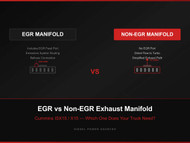
EGR vs Non-EGR Exhaust Manifold | Cummins ISX15 X15 Guide
Posted by DB on Mar 03, 2026
EGR vs Non-EGR Exhaust Manifold: Which One Does Your Cummins ISX15 / X15 Need?
One of the most common questions we get from ISX15 and X15 truck owners replacing an exhaust manifold on a deleted engine is whether it comes with an exhaust pressure port. They want to make sure they get the right Non-EGR or EGR manifold for their truck. It seems like a simple question, but the answer depends on how your truck is configured — and getting it wrong means the manifold either won't fit or won't work with your exhaust system.
This guide covers exactly what the difference is between the two, which OEM part numbers are involved, how the factory 3-piece manifold design works, and how to determine which manifold your Cummins ISX15 or X15 needs.
What Is the Difference Between EGR and Non-EGR Manifolds?
The difference between an EGR and Non-EGR exhaust manifold is not the turbo mounting flange or the overall shape of the manifold. Both versions bolt to the same cylinder head and both use the same 3-piece construction. The difference is whether the manifold includes a port that feeds exhaust gas to the EGR (Exhaust Gas Recirculation) system.
EGR Exhaust Manifold
An EGR exhaust manifold includes an additional port, typically located near cylinder #1 (the front of the engine), that connects to the EGR cooler through a bellows-style pipe. This port routes a portion of the exhaust gas back into the intake manifold. The EGR cooler reduces the temperature of that gas from over 500°F down to approximately 200°F before it re-enters the engine.
The purpose of this system is to lower combustion chamber temperatures, which reduces the formation of nitrogen oxides (NOx) — a regulated pollutant under EPA emissions standards. All 2010–2024 Cummins ISX15 and X15 engines were factory-equipped with EGR systems and shipped with EGR exhaust manifolds.
Non-EGR Exhaust Manifold
A Non-EGR exhaust manifold eliminates the EGR feed port entirely. Without this port, all exhaust gas flows directly from the cylinder head to the turbocharger through a simplified, uninterrupted path.
Because there is no factory ISX15 or X15 engine from 2010–2024 that shipped without EGR, Non-EGR manifolds are aftermarket designs. They are used on trucks where the EGR system has been removed, as well as off-highway, export, and other non-emissions applications.
Quick Comparison: EGR vs Non-EGR
| Feature | EGR Manifold | Non-EGR Manifold |
|---|---|---|
| EGR Feed Port | Yes — connects to EGR cooler via bellows pipe | No — port eliminated |
| Exhaust Flow Path | Split between turbo and EGR system | 100% of exhaust flows to turbocharger |
| Factory Use | All 2010–2024 EPA-compliant ISX15 / X15 engines | Aftermarket design for non-EGR configurations |
| Bellows Connection Required | Yes | No |
| Common OEM Part Numbers | 3687063, 3692604, 3689251, 3687062 | None — aftermarket performance design |
Why All 2010–2024 ISX15 / X15 Engines Came with EGR
Cummins introduced cooled EGR on the ISX platform in 2002 with the CM870 engine control module. By the time the ISX15 launched in 2010 with the CM2250 ECM, EGR was a fully integrated part of the emissions strategy alongside the Diesel Particulate Filter (DPF) and Selective Catalytic Reduction (SCR) system that uses Diesel Exhaust Fluid (DEF).
The ISX15 CM2250, CM2350, and the later X15 (introduced in 2017) all retained the cooled EGR system. This means every factory ISX15 and X15 truck from 2010 through 2024 originally shipped with an EGR-equipped exhaust manifold.
The key ECM platforms and their approximate production years are:
| ECM Platform | Approximate Years | EGR Equipped |
|---|---|---|
| CM2250 (ISX15) | 2010–2016 | Yes |
| CM2350 (X15) | 2013–2024 | Yes |
How the ISX15 / X15 3-Piece Exhaust Manifold Works
Regardless of whether you choose EGR or Non-EGR, the Cummins ISX15 exhaust manifold uses a 3-piece design. This is not unique to aftermarket manifolds — the factory manifold is also 3-piece. Understanding why this design is used helps explain many of the common manifold failures ISX owners experience.
The three sections are:
- Front section — Covers the front cylinders and routes exhaust toward the center
- Center section (turbo mount) — Collects exhaust from all six cylinders and mounts the turbocharger
- Rear section — Covers the rear cylinders and routes exhaust toward the center
This design exists because the ISX15 exhaust manifold operates under extreme temperature swings. During operation, the manifold heats to well over 1,000°F, then cools back down when the engine shuts off. A single-piece manifold spanning the full length of a 6-cylinder inline engine would experience severe thermal stress at the fixed mounting points, leading to cracking and warping.
By splitting the manifold into three sections, each piece can expand and contract independently. This significantly reduces the stress concentrations that cause cracking.
The trade-off is that the joints between sections must be sealed. Factory manifolds typically use seal-type connections at these joints, which can degrade over time and develop exhaust leaks. Aftermarket designs like the Diesel Power Source® manifold address this by hydraulically pressing the sections together, eliminating the seal-type joints entirely.
Common OEM Casting Numbers for ISX15 / X15 Manifolds
Truck technicians often identify manifolds by the casting number stamped directly on the part. If you're replacing a cracked manifold and need to confirm what you have, these are the most common numbers you'll find.
Complete Assembly Part Numbers (Superseded)
Cummins updates manifold part numbers over time as castings are revised. These are not different manifolds — they are successive revisions of the same basic design:
- 3687063
- 3689251
- 3692604
- 3687062
A typical supersession chain looks like: 3687063 → 3689251 → 3692604 → 3687062. All of these numbers reference the same EGR manifold assembly for ISX15 / X15 engines.
Center Section Casting Numbers (Turbo Mount)
- 3687063
- 3689251
- 3687062
- 3685284
- 3683789
End Section Casting Numbers (Front and Rear)
- 3683870
- 3685999
- 3685099
- 3684295
If your manifold carries any of these casting numbers, you have a standard Cummins ISX15 / X15 manifold assembly. The configuration (EGR vs Non-EGR) is determined by whether the manifold has the EGR feed port, not by the casting number itself.
How to Determine Which Manifold Your Truck Needs
The simplest way to determine which manifold you need is to check whether your truck currently uses the EGR bellows connection on the exhaust manifold.
If your truck has the bellows pipe connected from the exhaust manifold to the EGR cooler, you need the EGR exhaust manifold. This is the configuration found on all factory-emissions ISX15 and X15 trucks.
If your truck does not have the EGR bellows connection (because the EGR system has been removed or the truck operates in a non-emissions application), you need the Non-EGR exhaust manifold.
If you're not sure, the safest approach is to contact the Diesel Power Source® team.
Why Aftermarket Manifolds Are Worth Considering
Whether you need EGR or Non-EGR, upgrading from the factory manifold to an aftermarket performance manifold provides several real-world benefits for ISX15 and X15 engines.
The factory OEM manifold is built to a cost target. It works when new, but the seal-type joints between the 3-piece sections degrade over time. Combined with lower-grade casting materials, this leads to the cracking, warping, and exhaust leaks that ISX owners commonly deal with at higher mileage.
An upgraded aftermarket manifold like the Diesel Power Source® ISX15 manifold addresses these issues with improved materials and construction. The DPS manifold uses High Silicon with Molybdenum Ductile Iron (HSMD), which resists cracking, warping, and center divider erosion significantly better than standard cast iron. The press-fit 3-piece design eliminates the seal-type joints and the exhaust leaks that come with them.
The DPS manifold also delivers measurable performance improvements. CFD-optimized runner geometry produces up to 22% more exhaust flow than the stock manifold, which helps reduce exhaust gas temperatures by approximately 75–100°F. Lower EGTs reduce thermal stress on the turbo, head gaskets, and valves — extending the service life of those components as well.
ISX15 / X15 Exhaust Manifold Products from Diesel Power Source
Diesel Power Source® offers exhaust manifolds and related components for the full range of Cummins ISX15 and X15 configurations:
Manifolds
- Cummins ISX15 / X15 EGR Exhaust Manifold — For trucks with factory EGR (bellows connection)
- Cummins ISX15 / X15 Non-EGR Exhaust Manifold — For trucks without EGR
- ISX15 T6 Exhaust Manifold — For trucks running S400-series turbo conversions
Hardware and Gaskets
- ISX15 / X15 Exhaust Manifold Hardware Kit — Bolts, spacers, turbo studs, and nuts
- ISX15 / X15 Manifold Gasket & Turbo Flange Kit
- ISX15 / X15 Exhaust Manifold Bolt & Spacer Kit
Turbo Upgrades (Pair with Your New Manifold)
- HE400VG Turbo Replacement for Cummins ISX15 / X15 — 67mm and 70mm options
- HE400VG Turbo & Exhaust Manifold Kit — Complete turbo + manifold package
- S400 Cummins ISX15 / X15 Complete Turbo Conversion Kit
Summary
Every 2010–2024 Cummins ISX15 and X15 engine left the factory with an EGR-equipped exhaust manifold. The EGR manifold includes a port that routes exhaust gas to the EGR cooler for emissions compliance. The Non-EGR manifold eliminates this port and is used when the EGR system has been removed.
Both configurations use the same 3-piece manifold design, the same turbo mounting flange, and the same cylinder head bolt pattern. The only physical difference is the presence or absence of the EGR feed port and bellows connection.
If you're replacing a cracked or leaking manifold on your ISX15 or X15, check whether your truck currently has the EGR bellows pipe connected. That determines which version you need. If you're not sure, contact the Diesel Power Source® team with your Engine Serial Number and we'll confirm the right manifold for your configuration.