2nd Gen Swap vs 3rd Gen Swap: Which Cummins Conversion Is Better in 2026?
Posted by Diesel Power Source on May 25, 2026
If you own a 2007.5-2018 6.7 Cummins and you’re tired of the factory VGT turbo, you have two main paths to a permanent fix: a 2nd gen swap or a 3rd gen swap. Both replace the factory VGT system with a fixed-geometry single turbo, both eliminate VGT failure codes like P003A and P2262, and both can support 500 to 1,000+ horsepower with the right configuration. But the two approaches are fundamentally different in cost, install complexity, parts required, and end result.
This guide breaks down the real differences between a 2nd gen swap and a 3rd gen swap on a 6.7 Cummins. Which one is faster to install? Which one costs less? Which one performs better? And honestly, which one should you actually choose for your truck?
What Is a 2nd Gen Swap?
A 2nd gen swap on a 6.7 Cummins refers to converting the truck’s turbo and manifold layout to mimic the second-generation Dodge Ram setup from 1994-2002. The factory 6.7 VGT, factory manifold, and factory turbo location are all removed and replaced with a center-mount manifold (positioned the way 2nd gen 12V and 24V trucks were configured) plus a single fixed-geometry turbo mounted in the center-mount position.
The result is a turbo that sits in a different physical location than where the factory turbo lived — further forward and centered over the engine instead of toward the rear/passenger side. Because the turbo location changes, intercooler piping, intake piping, and exhaust piping all need to be re-routed or re-fabricated to fit the new turbo position.
2nd gen swaps were the original way to get rid of the factory VGT on a 6.7 Cummins back when there weren’t many other options. They work, they’ve been done thousands of times, and a properly built 2nd gen swap is reliable. But they’re labor-intensive and parts-intensive compared to newer alternatives.
What Is a 3rd Gen Swap?
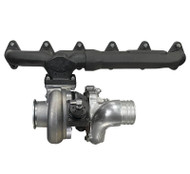
A 3rd gen swap on a 6.7 Cummins replaces the factory VGT and manifold with the turbo and manifold layout originally used on the 2003-2007 5.9 Cummins "third generation" trucks. The new turbo and manifold stay in the factory location — the same physical spot the factory VGT lived. The difference is the turbo type (fixed-geometry S300 instead of VGT) and the manifold (DPS multi-piece T3 design instead of factory single-piece T4i casting).
Because the turbo stays in factory location, the 3rd gen swap bolts directly to the stock exhaust connections, stock intake piping, and stock intercooler hose. No new piping required, no exhaust re-routing, no fabrication.
The 3rd gen swap is the newer approach. It was developed specifically to solve the VGT failure problem on 4th gen Ram trucks without the labor and parts cost of a full 2nd gen conversion. For most owners replacing a failing 6.7 VGT today, the 3rd gen swap is the more practical option.
2nd Gen Swap vs 3rd Gen Swap: Direct Comparison
Here’s how the two approaches compare on every metric that matters when making this decision.
Cost
- 2nd gen swap: Typically $3,000 to $4,000+ depending on parts quality and how complete the kit is. Custom or piecemeal builds can run higher. Most 2nd gen kits don’t include the manifold — that’s an additional purchase.
- 3rd gen swap: Starts around $2,099 for a complete kit including turbo, manifold, hardware, oil drain tube, and water block-off plugs. Significantly less because there are fewer parts and no custom piping required.
On cost alone, the 3rd gen swap typically saves $1,000-$2,000 over a comparable 2nd gen swap setup.
Installation Time
- 2nd gen swap: 6-10+ hours of install time, often more for first-time builders. Requires removing the factory turbo and manifold, installing the new manifold in the center-mount position, fabricating or installing new intercooler piping, re-routing intake piping, fitting an aftermarket exhaust downpipe, and getting all the connections to seal properly. This is a real shop project.
- 3rd gen swap: Approximately 3 hours on a deleted truck. Remove factory turbo and manifold, install DPS T3 manifold, bolt on S300 turbo, connect oil supply and drain, reconnect factory exhaust, factory intake, and factory intercooler hose. Done.
For a builder doing this in a driveway on weekends, the 2nd gen swap might take three weekends. The 3rd gen swap is realistically a single Saturday afternoon.
Parts Required
- 2nd gen swap: Turbo, 2nd gen-style center-mount exhaust manifold, intercooler piping kit (new tubes and couplers), intake piping, aftermarket downpipe, gaskets, fittings, oil supply line, oil drain line, hardware. The full parts list is significant and often pieced together from multiple suppliers.
- 3rd gen swap: Turbo, DPS T3 manifold, oil drain tube, water block-off plugs, gaskets and hardware. Everything fits in one box. Factory exhaust, intake, and intercooler connections are reused.
The 3rd gen swap parts list is dramatically shorter because it’s designed around keeping factory connections.
Turbo Location and Engine Bay Appearance
- 2nd gen swap: Turbo moves forward and centers over the engine. Looks more like a 2nd gen truck under the hood. Some builders prefer this aesthetic. Engine bay is more visually changed from stock.
- 3rd gen swap: Turbo stays in factory location (rear/passenger side of engine). Engine bay looks largely stock from above. Less visual change from factory.
This is a preference call, not a performance call. Both work equally well functionally.
Performance
This is where things get interesting. Both swaps use the same fundamental approach — a fixed-geometry S300 turbo replacing the factory VGT — so the core performance characteristics are similar. The differences are in the details:
- Spool-up: 3rd gen swaps using T3 wastegated housings often spool slightly faster than equivalent 2nd gen swaps using T4 non-wastegated housings, because the smaller A/R of the T3 housing accelerates exhaust gas velocity at lower RPM. This is most noticeable in the towing and daily-driving RPM range.
- Top-end power: 2nd gen swaps using T4 housings can support marginally higher peak power at extreme builds (1,000+ HP) because of the larger A/R capability. For most builds under 800 HP, the difference is negligible.
- EGTs: Both swaps drop EGTs meaningfully versus a worn or marginal factory VGT. The differences between 2nd gen and 3rd gen here are within noise.
- Exhaust brake: Neither factory exhaust brake works after either swap. Both can add exhaust braking back through the optional Turbonator® VGT upgrade.
For 95% of builds (under 800 RWHP), performance differences between a properly-built 2nd gen and 3rd gen swap are within margin of error. The fundamental power comes from the turbo choice (S363, S366, S369, etc.) rather than the swap style.
Exhaust Brake Capability
Both swaps eliminate the factory VGT, which means the factory exhaust brake function is lost. Owners who tow heavily often want exhaust braking back. Both swaps can solve this with a Turbonator® VGT upgrade — a DPS-engineered variable geometry housing for S300 turbos that adds exhaust braking and faster spool while keeping the swap’s simplicity and reliability.
The Turbonator® VGT works on both 2nd gen and 3rd gen swaps. No difference between the two approaches here.
Emissions Compatibility
Both swaps are designed for trucks that have already been deleted. Neither retains factory EGR, DPF, or DEF functionality. DPS does not sell or provide emissions delete components — the customer is responsible for that side of the build.
If you want to upgrade your turbo without removing emissions equipment, neither swap is the right path. The right path for an emissions-intact truck is either a stock-replacement VGT upgrade (HE300VG with a larger compressor) or the add-a-turbo compound kit, both of which keep emissions equipment functional.
Future Upgrade Path
- 2nd gen swap: Can be expanded into a compound kit by adding a larger atmospheric turbo. The center-mount manifold supports compound configurations directly.
- 3rd gen swap: The S300 turbo from a 3rd gen swap can be reused as the high-pressure (small) turbo in a future compound setup if you order it with a spring gate instead of a wastegate.
Both paths can grow into compound systems. The 2nd gen swap is more "compound-ready" out of the box, but a 3rd gen swap is no harder to upgrade later if you specified it correctly at order time.
Side-by-Side Comparison Table
| Feature | 2nd Gen Swap | 3rd Gen Swap (DPS) |
|---|---|---|
| Typical cost | $3,000-$4,000+ | Starting at $2,099 |
| Install time | 6-10+ hours | ~3 hours (deleted truck) |
| Turbo location | Center-mount (moved forward) | Factory location (unchanged) |
| Intercooler piping | New piping required | Reuses stock piping |
| Intake piping | New piping required | Reuses stock intake |
| Exhaust downpipe | Aftermarket required | Reuses stock exhaust |
| Manifold included | Often separate purchase | Included (DPS 2-piece T3) |
| Exhaust brake (optional) | With Turbonator® VGT | With Turbonator® VGT |
| HP capability | 500-1,000+ HP | 500-1,000 HP |
| Future compound upgrade | Yes | Yes (spec spring gate at order) |
| Engine bay appearance | Significantly changed | Mostly stock looking |
Which Swap Should You Actually Choose?
Use this decision framework to figure out which path fits your situation:
Choose a 3rd Gen Swap if:
- You want the lowest cost path to permanently fix a failing factory VGT
- You want the fastest install (single Saturday vs multi-weekend project)
- You don’t want to deal with fabricating or buying new intercooler and intake piping
- You prefer the engine bay to look mostly stock
- Your power goal is in the 500-800 RWHP range (which covers most daily-driver and tow builds)
- You want a complete kit in one box from one supplier
- You’re a first-time builder or doing the work yourself in a driveway
For most 6.7 Cummins owners experiencing VGT failure, the 3rd gen swap is the better answer. It costs less, installs faster, and delivers equivalent real-world performance for under-800-HP builds. Browse the DPS 3rd Gen Swap Kit options.
Choose a 2nd Gen Swap if:
- You specifically want the 2nd gen aesthetic with the turbo centered over the engine
- You’re building toward an extreme power goal (1,000+ RWHP) where T4 housing flow matters
- You’re planning a compound build and want the manifold layout pre-configured for it
- You’re comfortable fabricating or sourcing the additional piping yourself
- The labor cost difference doesn’t matter to you (DIY build, or your shop time is "free")
For builders specifically chasing the 2nd gen look, planning a compound kit, or chasing 1,000+ HP, the 2nd gen approach has a place. For everyone else, the 3rd gen swap is usually the better tool for the job.
Common Questions
Is a 3rd gen swap as reliable as a 2nd gen swap?
Yes. Both approaches replace the factory VGT with the same family of fixed-geometry S300 turbos and the same supporting components. Reliability is essentially identical because the turbocharger itself is the most failure-prone part — and both swaps use the same turbo platform. The difference is install complexity and cost, not durability.
Can I do a 3rd gen swap and then add a second turbo later for compounds?
Yes, with one important detail: when you order the 3rd gen swap turbo, specify that you may compound it later. DPS will set the turbo up with a spring gate (instead of a wastegate) so it’s ready to function as the high-pressure (small) turbo in a future compound system. Without that spec, the wastegated turbo will still work but isn’t optimized for compound use.
Do I need a programmer or tuner for a 2nd gen or 3rd gen swap?
Yes. Both swaps require the truck to have already been deleted, which requires a programmer that removes emissions equipment from the ECM. DPS doesn’t sell programmers or delete components — that’s the customer’s responsibility before installing either swap kit. Many of our customers have their tuner of choice handle this side of the build.
Will a 2nd gen or 3rd gen swap pass emissions inspection in my state?
No. Both swaps require emissions equipment removal to function. If you live in a state with annual emissions testing, neither swap is the right path for your truck unless you’re willing to swap factory equipment back on for inspection. For trucks needing to retain emissions, the add-a-turbo compound kit or stock-replacement VGT upgrade are the right options.
Which swap keeps the factory exhaust brake?
Neither swap retains the factory exhaust brake automatically. The factory exhaust brake works through the factory VGT — once that’s removed, the brake function goes with it. Both swaps can add exhaust braking back through the optional Turbonator® VGT upgrade. The Turbonator® VGT is a DPS-engineered variable geometry housing that gives the swap’s S300 turbo full exhaust braking capability plus 200-300 RPM faster spool. It’s a popular upgrade for owners who tow.
How much horsepower can a 2nd gen or 3rd gen swap support?
Both swaps support roughly the same horsepower range — approximately 500 RWHP at the low end with a smaller S300 like an S363, scaling up to 800 RWHP with an S369 or 1,000 HP with S400 VGT options. The turbo choice within the swap kit matters far more than the swap style itself. Most daily/tow builds land between 530-650 RWHP regardless of which swap approach is used.
What turbo size should I pick for my 3rd gen swap?
For daily drivers and tow rigs running stock or mild fueling, the S363/73/.80 is the most popular choice — quick spool, around 530 RWHP capability, great street manners. For more power with strong fueling upgrades, the S366/73/.80 is the sweet spot at around 650 RWHP. For higher-HP builds, the S369/73/.80 handles up to 775 RWHP. The right choice depends on your power goal, supporting modifications, and how the truck gets used. When in doubt, call us at 801-930-8404 and we’ll help you size it correctly.
The Bottom Line
Both 2nd gen and 3rd gen swaps work. Both eliminate factory VGT problems permanently. Both can support serious horsepower with the right configuration. But the practical reality for most 6.7 Cummins owners is that the 3rd gen swap delivers the same end result with less cost, less labor, fewer parts, and less fabrication.
For trucks targeting under 800 RWHP — which covers nearly all daily drivers, tow rigs, and weekend builds — the 3rd gen swap is typically the smarter choice. The 2nd gen approach has a place for specific use cases (1,000+ HP builds, aesthetic preferences, compound-first planning) but it’s no longer the default option it once was.
At Diesel Power Source, we manufacture both the parts and complete kits to support whichever approach fits your build. Browse the DPS 3rd Gen Swap Kit for the complete bolt-on solution, the S300 single turbo lineup to see your turbo size options, or the 5.9 Cummins manifold lineup for the multi-piece manifolds that work in either swap configuration. For complete 6.7 turbo upgrade context including emissions-intact options, see our 6.7 Cummins turbo upgrade guide. If you're considering compounds instead of a swap kit,
see our Compound Turbos for Cummins guide.
If you’re unsure which path fits your truck, call us at 801-930-8404 or email sales@dieselpowersource.com. We’ve helped thousands of 6.7 Cummins owners through this decision — happy to talk through your specific build.